7 illegal miners die in clash with military at Obuasi mines
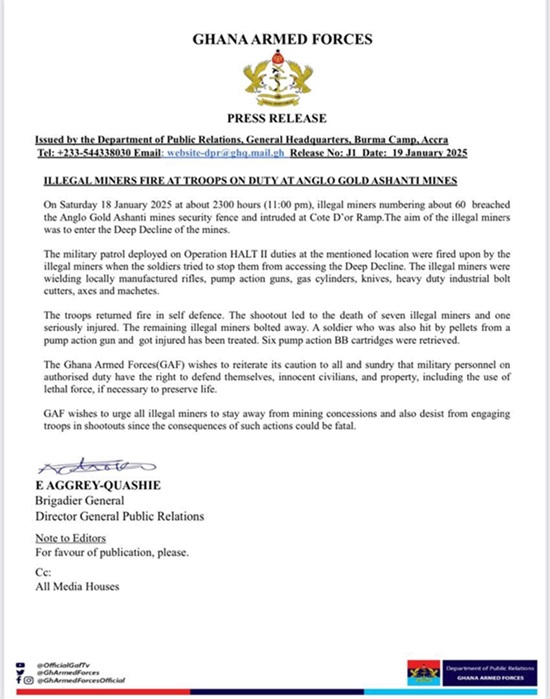
The Ghana Armed Forces (GAF) has confirmed that seven illegal miners were killed during a shootout with military personnel at the AngloGold Ashanti Mines on Saturday, January 18, 2025.
In a statement issued by the GAF, the incident occurred at approximately 11:00 PM when a group of about 60 illegal miners breached the security fence at the Cote D’or Ramp and attempted to access the Deep Decline section of the mining concession.
The intruders, armed with locally manufactured rifles, pump-action guns, gas cylinders, knives, heavy-duty industrial bolt cutters, axes, and machetes, reportedly opened fire on the military patrol deployed under Operation HALT II.
Acting in self-defense, the troops returned fire, resulting in the death of seven illegal miners. One additional miner sustained serious injuries, while the rest of the group fled the scene.
Military Personnel Injured
The GAF reported that one soldier was injured after being hit by pellets from a pump-action gun during the encounter. The injured soldier has since received medical treatment.
Weapons recovered from the scene included six pump-action BB cartridges, underscoring the threat posed by the armed miners.
GAF’s Caution Against Illegal Mining Activities
Brigadier General E. Aggrey-Quashie, Director General of Public Relations for the Ghana Armed Forces, reiterated that military personnel on authorized duty are entitled to defend themselves, civilians, and property, including the use of lethal force if necessary.
The GAF cautioned illegal miners to avoid engaging in confrontations with security forces and to stay away from mining concessions, warning that such actions could have fatal consequences.
Illegal Mining: A Persistent National Challenge
Illegal mining, or “galamsey,” continues to pose a significant threat to Ghana’s environment and economy. Despite efforts to curb these activities through initiatives like Operation HALT II, mining concessions, including those operated by AngloGold Ashanti, remain vulnerable to incursions.
The GAF stressed their commitment to addressing illegal mining and protecting the nation’s resources, highlighting the critical role of law enforcement in safeguarding strategic assets.