Cedi Gains Reflect Discipline, Not Permanence — BoG Governor
Bank of Ghana Governor Dr Johnson Pandit Asiama has warned that the recent strengthening of the cedi must not be mistaken for permanence, stressing that exchange-rate stability is earned through sustained discipline, productivity and credible economic management.
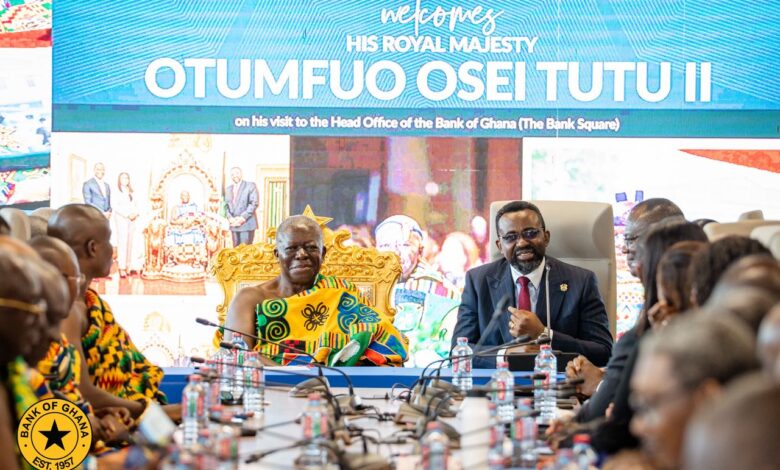
Speaking during a courtesy visit by the Asantehene, Otumfuo Osei Tutu II, to the Bank of Ghana on January 7, 2026, Dr Asiama said the currency’s performance reflects improving fundamentals but should be treated as a responsibility rather than a victory. He recalled an earlier question from the Asantehene on whether the cedi’s appreciation was sustainable — a concern that, he said, mirrors the doubts of households, traders and businesses across the country.
Dr Asiama said Ghana’s macroeconomic foundations have strengthened markedly over the past year. Inflation fell sharply from 23.8 percent in December 2024 to 5.4 percent in December 2025, driven by sustained monetary discipline, improved food supply conditions and closer coordination between the Bank of Ghana and the Ministry of Finance. As inflation pressures eased, the central bank was able to recalibrate policy, cutting the Monetary Policy Rate from 27 percent to 18 percent by November 2025 while maintaining prudent financial conditions.
External buffers have also been rebuilt. Gross international reserves rose to about $13.83 billion by the end of 2025, providing close to six months of import cover, while trade performance and confidence in macroeconomic management improved. Against this backdrop, the cedi ended 2025 stronger than many analysts had anticipated, closing the year at about GH¢10.67 to the US dollar and ranking among Africa’s better-performing currencies.
Despite these gains, the Governor cautioned against complacency, emphasising that currency stability cannot be declared but must be sustained. He said a strong cedi ultimately depends on a productive, competitive and disciplined real economy, anchored by fiscal restraint, export-led growth and long-term policy thinking rather than short-term comfort.
Dr Asiama linked economic stability to national values, praising the Asantehene’s consistent advocacy for reduced waste, protection of public resources and development that creates real opportunities for ordinary citizens. He said Ghana’s recovery must now move beyond improved statistics to better livelihoods, including job creation, stronger local industry and access to affordable credit that does not reignite inflation.
He reaffirmed the Bank of Ghana’s commitment to operating independently and professionally to ensure that recent gains translate into durable and inclusive growth, describing the Asantehene’s visit as timely and symbolic of the patience and collective responsibility required to sustain both social and economic stability.