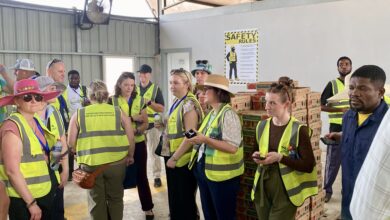
VePEAG Urges Govt to Revamp Irrigation to Boost Local Tomato Production
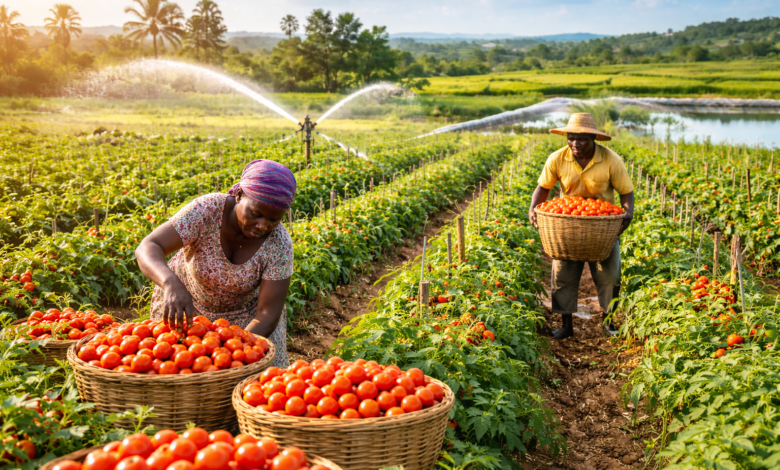
The Vegetable Producers and Exporters Association of Ghana (VePEAG) has renewed calls on government to urgently revamp Ghana’s irrigation infrastructure to support large-scale local tomato production, following a recent attack on Ghanaian tomato traders in neighbouring Burkina Faso.
The Association said the incident, involving Ghanaian women travelling to purchase tomatoes for the local market, once again exposes the security and economic risks associated with Ghana’s reliance on cross-border tomato supply chains.
In a statement reacting to the attack, VePEAG expressed sadness over the incident and warned that repeated attacks along key Sahel trade routes pose growing dangers to Ghanaian traders who travel outside the country to source basic food commodities.
Reducing Dependence, Strengthening Food Security
VePEAG stressed that Ghana’s continued dependence on imported tomatoes is not only a security risk but also a food security concern that requires structural solutions.
According to the Association, reviving and expanding irrigation facilities across the country would enable year-round tomato production, reduce supply shortages, stabilise prices and eliminate the need for traders to undertake dangerous journeys outside Ghana.
“The recent attack has happened severally in the past, and it reinforces the need for government to act decisively by revamping the many irrigation facilities across the country for tomato production to meet local demand,” the Association stated.
Local Capacity Exists
VePEAG said Ghana already has the resources, expertise and favourable agro-ecological conditions required to produce high-quality tomatoes at scale, noting that the challenge lies more in infrastructure and policy support than technical capacity.
The Association committed its members’ energies and expertise to supporting local tomato production, saying stronger collaboration between government, farmers and traders could rapidly reduce Ghana’s dependence on external supply.
“We believe the resources and expertise required for high-quality tomato production are found here in Ghana,” the statement said, calling for immediate action by government and relevant stakeholders.
Addressing the Root of the Problem
Industry players argue that the recurring tomato supply challenge reflects deeper issues, including underutilised irrigation schemes, post-harvest losses and weak coordination between production and market demand.
VePEAG said tackling these root causes would not only protect traders from security risks but also strengthen Ghana’s agricultural value chain, create jobs and improve rural incomes.
A Call for Policy Action
The Association urged government to treat the incident as a wake-up call, linking agricultural investment directly to national security and food resilience.
By prioritising irrigation-led tomato production, VePEAG said Ghana can reduce exposure to regional instability, improve food self-sufficiency and ensure safer livelihoods for traders who currently bear the risks of cross-border sourcing.