Mahama Heads to UK on Accra Reset Talks, to Davos for WEF
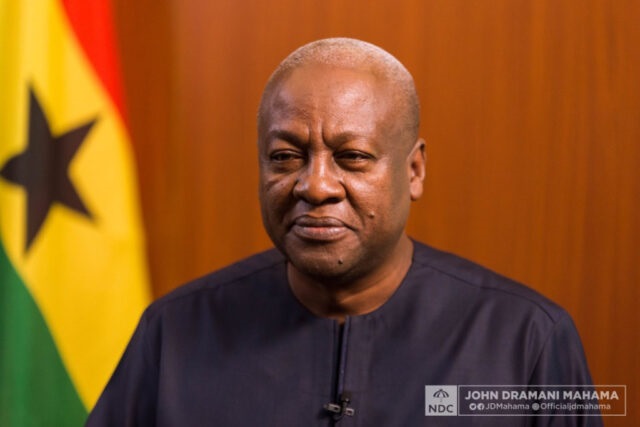
President John Dramani Mahama’s engagement at the World Economic Forum (WEF) in Davos this week marks an early effort to project Ghana’s economic reset to global investors, policymakers and business leaders.
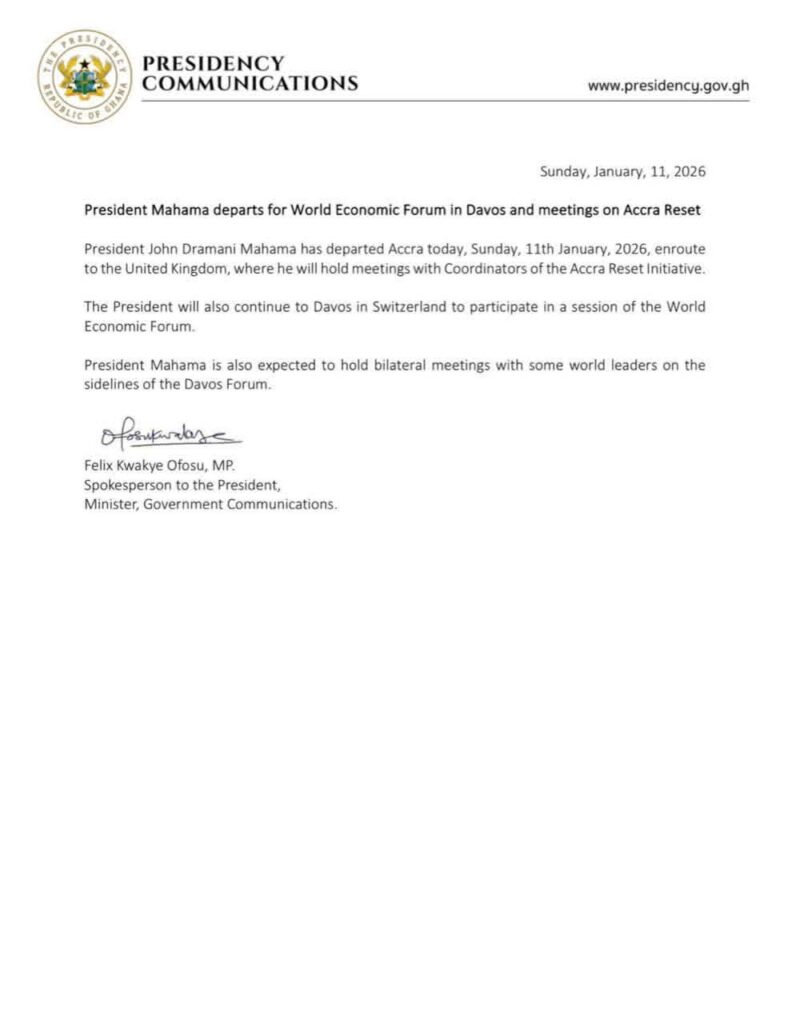
A statement from the Presidency said the President departed Accra on Sunday for the United Kingdom, where he will hold meetings with coordinators of the Accra Reset Initiative before proceeding to Switzerland for the annual WEF meeting. He is also expected to hold bilateral discussions with world leaders and senior executives on the sidelines of the forum.
For Ghana’s business community, the trip underscores the administration’s intent to align domestic economic reforms with international capital and partnerships at a time when investment confidence and financing remain critical to recovery.
The Accra Reset Initiative has emerged as a central plank of the government’s economic narrative, framed around restoring macroeconomic stability, strengthening governance and reorienting growth toward productivity, exports and private-sector expansion. Meetings in London are expected to focus on refining that agenda with development partners and investors ahead of broader global engagement.
Davos provides a high-level platform to advance those objectives. The forum brings together political leaders, multinational corporations, financiers and development institutions, offering Ghana an opportunity to reposition itself in a competitive global investment landscape. For emerging markets, the WEF has increasingly become a venue for shaping investor perceptions as much as formal diplomacy.
President Mahama’s participation comes as Ghana works to rebuild credibility after recent economic strains, including debt restructuring and currency pressures. By anchoring discussions around the Accra Reset Initiative, the government appears focused on projecting policy direction and reform consistency rather than short-term crisis management.
Bilateral engagements are expected to centre on infrastructure development, energy transition, agribusiness and value-added manufacturing sectors viewed as critical to exports, job creation and long-term growth. Analysts say such discussions are essential for translating policy signals into concrete investment flows.
As global economic uncertainty persists, Ghana’s presence at Davos, preceded by consultations in the UK, reflects a strategy to reconnect domestic reforms with international investors and institutions. How far those engagements convert into tangible commitments will be closely monitored by businesses and markets at home.