GIPA’s New Mandate Signals Push to Build Ghanaian Multinationals
Ghana is moving to build a new class of indigenous companies capable of raising capital at home, expanding across Africa and eventually competing as multinational businesses, as the country’s investment promotion strategy takes a new direction.
The shift is being driven partly by the expanded mandate of the Ghana Investment Promotion Authority (GIPA), which under the Ghana Investment Promotion Authority Act, 2026 (Act 1173), is now expected to promote and facilitate outward investment by Ghanaian enterprises.
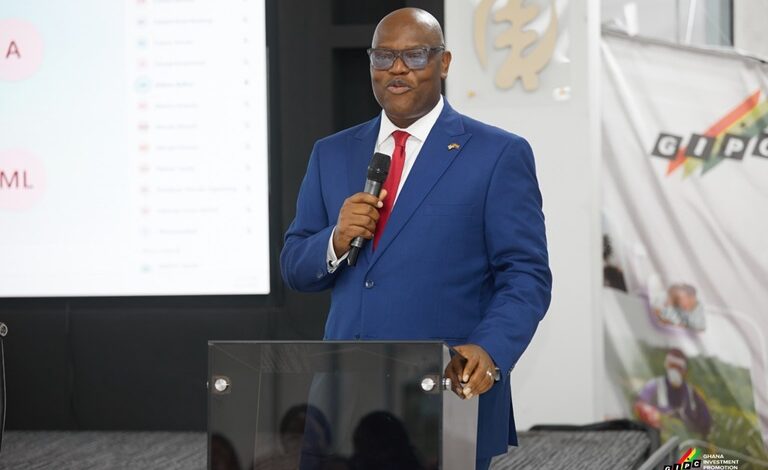
For GIPA Chief Executive Officer, Simon Madjie, the change reflects a recognition that Ghana’s economic development cannot depend on attracting foreign companies into the country alone.
“We also need strong domestic businesses that can invest, expand, form partnerships with international institutions, and become major players in their respective industries,” he said.
Madjie was speaking at the Ghana Stock Exchange’s admission of Petrosol Platinum Energy PLC’s GH¢200 million bond programme to the fixed income market.
His remarks put the Petrosol transaction in a broader context: the development of a domestic financing system capable of helping Ghanaian businesses grow large enough to take advantage of the African market.
From attracting investors to creating investors
For years, Ghana’s investment promotion efforts have largely centred on bringing foreign capital into the country.
Madjie’s address pointed to a second dimension: helping Ghanaian businesses become investors themselves.
Under the new law, GIPA has a specific role in facilitating outward investment by local companies seeking opportunities beyond Ghana.
That could change the relationship between Ghanaian businesses and the wider African market.
Rather than limiting local companies to the domestic economy, the policy seeks to support firms that can establish operations in other African countries, enter regional value chains and build customer bases across the continent.
The African Continental Free Trade Area provides a major market for that strategy.
But the opportunity also exposes a weakness: many Ghanaian businesses do not yet have the scale, capital or systems required to compete across multiple African markets.
Capital is the missing link
This is where Madjie’s comments on the capital market become more significant.
He said access to long-term capital remained a major constraint for private businesses, despite the existence of substantial domestic savings held by pension funds, insurance companies and other institutional investors.
The Ghanaian capital market could help bridge that gap by connecting those pools of savings with businesses capable of deploying the funds productively.
The figures he cited suggest that the market is already capable of mobilising substantial capital.
Corporate issuers have raised more than GH¢24 billion through 119 admitted tranches since the establishment of the fixed income market.
Between January and July 2026, trading in corporate securities reached GH¢33.71 billion, compared with GH¢2.63 billion during the corresponding period of 2025.
Yet corporate securities accounted for only 1.43 per cent of total trading volume over the period.
That relatively small share points to a financing market that remains heavily dominated by government securities, while the private sector’s potential demand for long-term capital remains largely untapped.
Petrosol provides a template
Petrosol’s GH¢200 million bond programme provides an example of how a Ghanaian company can use the market to strengthen its financing base.
For businesses seeking to expand, access to longer-term funding can reduce reliance on traditional bank financing and provide capital for investments that may take several years to generate returns.
The significance for GIPA goes beyond Petrosol’s own expansion.
If more Ghanaian companies can build strong balance sheets, improve governance and access domestic capital markets, they will be better positioned to pursue opportunities created by AfCFTA.
That could gradually produce companies with the scale to invest outside Ghana rather than relying mainly on foreign companies to drive cross-border investment.
Governance becomes part of the growth strategy
Madjie also made clear that access to capital comes with greater accountability.
Companies that raise funds from investors must provide timely disclosures, maintain sound financial controls, strengthen board oversight, manage risks and honour their obligations.
That requirement is particularly important if Ghana wants to develop companies capable of competing internationally.
Regional expansion requires more than money. Companies need credible management, reliable financial systems, strong governance and the ability to convince investors and international partners that they can manage larger and more complex operations.
The capital market can therefore serve not only as a source of financing but also as a mechanism for improving corporate discipline.
The bigger economic objective
The broader objective is to move Ghanaian businesses up the investment ladder.
A company that can raise long-term capital in Ghana can invest in additional production capacity. A stronger company can enter neighbouring markets. Successful regional expansion can create a Ghanaian business with revenues and assets across Africa.
That process could deepen Ghanaian ownership of businesses operating across the continent and allow more of the returns from African economic growth to accrue to Ghanaian investors and companies.
Madjie said GIPA would support Ghanaian businesses seeking to expand into Africa and other international markets.
The challenge now is whether Ghana can create enough companies with the financial strength and governance standards to take advantage of that opportunity.
The Petrosol transaction, in that sense, is less about one bond issue than about a bigger question for Ghana’s economy: can the country develop a financial and investment ecosystem that produces Ghanaian companies capable of competing beyond its borders?