
While Ghana Mines What Will Finish, Maphlix Trust Grows What Can Last

President John Dramani Mahama did not mention Maphlix Trust Ghana by name when he addressed exporters at the President’s National Awards for Export Achievement. Yet his remarks framed, with unusual clarity, why enterprises like it matter to Ghana’s economic future.
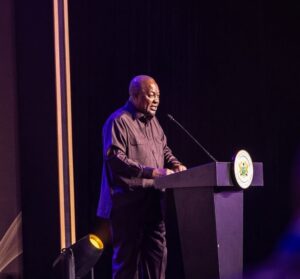
As he cautioned that crude oil and gold are finite resources that will one day be exhausted—he pointed to exporters in agriculture and manufacturing as “the real drivers of the economy,” sectors capable of outliving depletion. It was an implicit acknowledgment of a long-standing but poorly executed truth: extractive wealth fades; productive systems endure.
That context gives deeper meaning to the recognition of Maphlix Trust Ghana Limited, named Exporter of the Year (SME Category) at the 33rd and 34th edition of the awards. Beyond the symbolism of the honour, the company represents the type of export architecture Ghana has repeatedly promised to build, yet rarely scaled.
For decades, Ghana’s export strategy has been heavy on policy declarations, that’s diversification, value addition, resilience but light on execution. The economy remains anchored to a narrow base, dominated by cocoa, gold and oil, exposing it to volatility and long-term exhaustion.

The citation accompanying Maphlix Trust Ghana’s award reads almost like a counter-argument to that trajectory.
It credits the company with integrating sustainable production, value-chain enhancement and community-centred development concepts often treated as separate ambitions—into a single operating model. This matters because Ghana’s export challenge has never been a shortage of crops or farmers, but the failure to organise them into durable, market-facing systems.
The company’s large-scale promotion and commercialisation of Alafie Wuljo, the so-called “healthy potato,” illustrates that approach. Rather than exporting an undifferentiated commodity, Maphlix Trust Ghana repositioned a local crop around nutrition, climate resilience and export readiness. In doing so, it demonstrated how indigenous agriculture can be retooled for global markets without severing links to smallholder production.
That link is central to the company’s model. The citation highlights deliberate investments in farmer capacity building, post-harvest optimisation and export quality certification, alongside the integration of smallholder farmers into formal markets. In an economy where smallholders account for most agricultural output yet remain marginal to exports, this represents structural intervention rather than incremental improvement.
Equally telling is the firm’s alignment with international sustainability frameworks, including the UN Global Compact and COLEACP’s sustainability charter. As access to global markets becomes increasingly defined by compliance, traceability and environmental standards, this alignment positions Ghanaian exports not as late adopters, but as credible participants in premium supply chains.

Trade and Agribusiness Minister Elizabeth Ofosu-Adjaye reinforced this perspective, noting that while cocoa, gold and oil remain important, Ghana’s resilience is increasingly being built elsewhere across agribusiness, manufacturing and services that add value locally and export under the Made-in-Ghana banner. Diversification, she argued, is no longer theoretical; it is already being practised by firms operating beyond traditional export strongholds.
Seen through this lens, Maphlix Trust Ghana’s recognition is less a celebration of corporate success than a form of policy validation. It confirms that Ghana’s export ambitions are achievable and already underway but largely at the margins.
CEO of Maphlix Trust, Dr Felix Mawuli Kamassah described the President’s National Export Awards as more than a celebratory platform, arguing that they should serve as a signal to policymakers on which export models are working and deserve deliberate scaling. He said the focus on exporters who repatriate their earnings underscores the link between trade performance, foreign exchange stability and broader economic management.

He stressed that Ghana’s ambition to grow agribusiness exports cannot be achieved through recognition alone, but will require coordinated institutional support, particularly from GEPA and the Ghana Export–Import Bank (GEXIM), to address financing gaps, market access constraints and value-chain inefficiencies.
Dr Kamassah noted that with the right mix of targeted funding, export development support and value addition incentives, agribusiness firms can move beyond pilot successes to deliver sustained growth, positioning the sector as a key contributor to the country’s $10 billion export target and a more resilient foreign exchange base.
The unresolved issue is not knowledge or strategy. The citation makes clear that the blueprint exists. The real test is whether the state will move beyond applauding such enterprises to deliberately scaling them aligning finance, infrastructure, regulation and market access around models that already work.
Until that happens, awards will continue to highlight what Ghana could become, even as the economy remains constrained by what it has long depended on.