UN at 80: Guterres Warns Multilateralism Under Strain as Global Crises Deepen
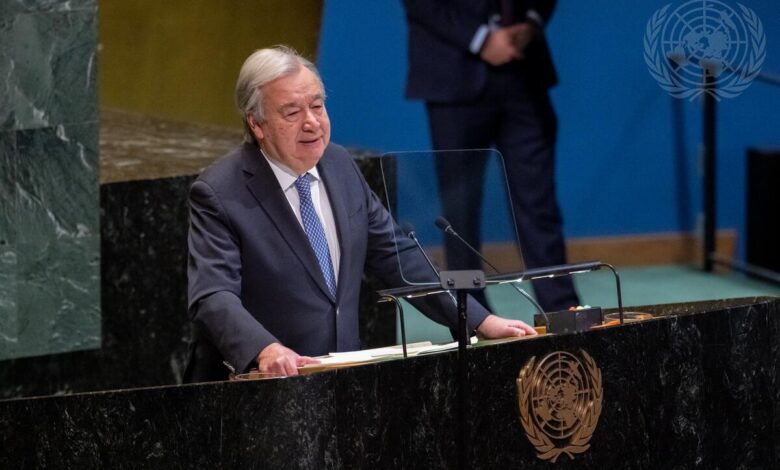
United Nations Secretary-General António Guterres has warned that the multilateral system is facing its most severe test in decades, even as global challenges grow more complex, interconnected and borderless.
Speaking in London at an event organised by the United Nations Association of the United Kingdom to mark the 80th anniversary of the UN General Assembly, Mr. Guterres said the world is confronting a dangerous convergence of conflict, inequality, climate chaos and the erosion of international law, at a time when cooperation is most needed.
Reflecting on the origins of the United Nations, he recalled that the General Assembly and the Security Council first met in a city still scarred by the devastation of World War II. Delegates gathered above an air-raid shelter where civilians had once huddled for safety during the Blitz, united by a shared determination to “save succeeding generations from the scourge of war.”
That history, he said, remains a powerful reminder of the UN’s purpose as a place where humanity invests its hope for peace, security and a better life.
A World More Divided, Yet More Connected
Looking back to his first address to the UNA-UK in 2017, the Secretary-General noted that many of the risks he warned about then have since intensified. Local conflicts have spilled across borders, artificial intelligence has reshaped economies at unprecedented speed, and national sovereignty has increasingly been used to justify the erosion of human rights.
Over the past decade, conflicts in Gaza, Ukraine and Sudan have inflicted immense human suffering, while the COVID-19 pandemic fuelled nationalism and stalled progress on development and climate action. These crises, he said, underscore a central lesson: today’s challenges do not stop at national borders and cannot be solved by countries acting alone.
Yet, he cautioned, the very system designed to enable collective action is under growing pressure.
Strain on International Cooperation
Mr. Guterres described 2025 as a deeply troubling year for global cooperation. Development aid was cut, inequalities widened, climate impacts intensified and international law was repeatedly violated. Journalists and civil society actors faced crackdowns, while United Nations staff were increasingly threatened or killed in the line of duty.
At the same time, global military spending surged to a record $2.7 trillion, even as resources for development and humanitarian action remained constrained. Fossil fuel profits continued to rise amid record global temperatures, while digital platforms and algorithms amplified disinformation, hate and authoritarian control.
“These are powerful forces lining up against global cooperation,” he warned.
Reasons for Hope Amid the Turbulence
Despite these challenges, the Secretary-General insisted that multilateralism continues to deliver, often quietly and without headlines. He pointed to the entry into force of the Agreement on Marine Biological Diversity of Areas beyond National Jurisdiction, which establishes the first legal framework to protect biodiversity in international waters covering two-thirds of the world’s oceans.
The treaty, he said, was a model of modern diplomacy, grounded in science and inclusive of governments, civil society, Indigenous Peoples and local communities.
“These quiet victories of international cooperation are real, and they matter,” he said.
Reforming the System for Today’s World
As global power dynamics shift, Mr. Guterres argued that the international system must evolve to reflect contemporary realities or risk becoming increasingly unstable and unfair. He highlighted the UN80 initiative and the Pact for the Future as efforts to make the United Nations more agile, coordinated and responsive.
Central to this agenda, he said, are reforms of the Security Council and the international financial architecture, which he described as unjust and outdated. Those who cling to entrenched privileges, he warned, may ultimately undermine their own interests.
“The circumstances demand nothing less than bold change,” he said, urging today’s leaders to draw inspiration from the courage of those who founded the UN in the aftermath of war.
The Role of Civil Society
In closing, Mr. Guterres emphasised that multilateralism does not begin in UN halls alone, but with people’s movements and civil society organisations that demand cooperation, justice and accountability. At a time when the values of global solidarity are under sustained attack, he called on citizens, professionals and voters to take a stand.
Rejecting the notion that peace is naïve, he reminded his audience that the founders of the United Nations were shaped by the brutal realities of war. Their pursuit of peace, justice and equality, he said, was not idealism, but the most practical and courageous response to a broken world.
“As humanity’s challenges grow, our duty is to serve with the same sense of urgency,” he said, calling for renewed commitment to justice, humanity and peace as the United Nations enters its ninth decade.