Ghana’s Cedi Crisis: The Problem Is Not What You Think

At the 2026 Dean of Business School Lecture Series at the University of Professional Studies, Accra (UPSA), economist and CEO of Dalex Finance – Joe Jackson delivered a bold and unsettling message: Ghana’s exchange rate crisis is widely misunderstood and until that misunderstanding is corrected, the cedi will remain under pressure.
The numbers are striking. Between 2016 and 2024, the cedi lost nearly 71% of its value against the US dollar. Yet in a surprising twist, it rebounded with a 40% appreciation between 2024 and 2025. The story, Jackson argues, is not simply one of decline but of dangerous volatility.
But the real insight lies beneath the surface.
Contrary to popular belief, Ghana’s cedi is not weak because the country cannot export. In fact, Ghana has consistently recorded positive trade balances in recent years. The problem is not exports, rather, it is what happens after exports.
Ghana earns foreign exchange from gold, oil, and cocoa. But much of that value does not stay in the country. It leaks out through service imports, profit repatriation, debt servicing, and capital flight. In 2024 alone, Ghana posted a trade surplus of $5.1 billion but lost nearly $8 billion through these leakages.
In simple terms: Ghana earns dollars and then sends them right back out.
Even more concerning is the scale of the gold sector. Ghana exported approximately $11.9 billion worth of gold yet retained less than half of that value domestically. Countries like South Africa and Botswana, by contrast, retain a much larger share of export value even with lower export volumes.
This leads to a powerful conclusion: Ghana’s currency problem is structural, not cyclical.
To address part of this challenge, the government introduced GOLDBOD—the Ghana Gold Board. According to Jackson, GOLDBOD has delivered meaningful early results. By centralizing gold purchases, aligning local prices with international markets, and formalizing small-scale mining, the initiative has significantly increased gold export volumes and value. Early estimates suggest a potential 75% increase in export value, with artisanal mining contributions more than doubling.
But there is a catch.
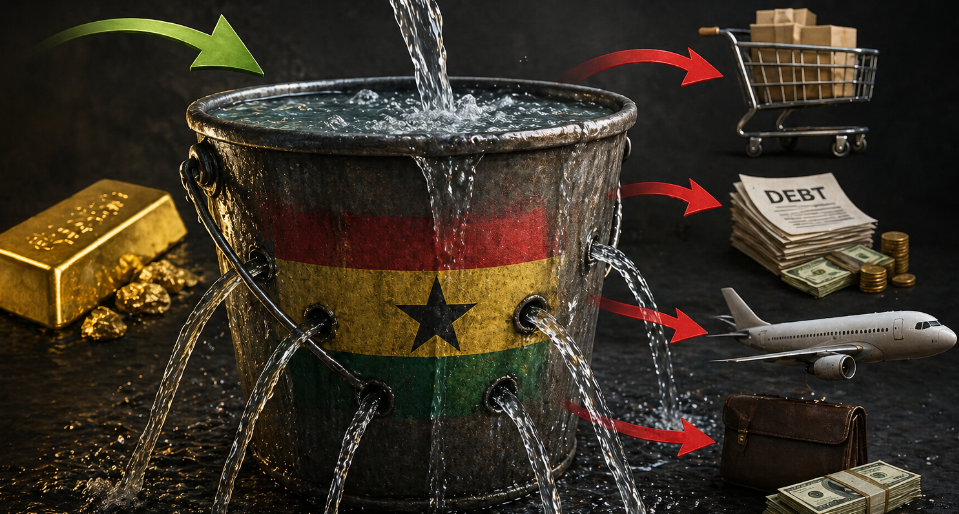
While GOLDBOD improves export value retention, it does not address the largest sources of foreign exchange leakage. Service imports, profit repatriation, and debt servicing continue to drain the system. As Jackson puts it, “Kudos to GOLDBOD but the leakages remain.”
And even if Ghana solved the leakage problem, another threat looms: inflation.
Ghana’s inflation surged to 54% in 2022 and remained elevated through 2024, far exceeding inflation levels in the United States. This gap matters. Over time, higher inflation makes local goods more expensive, encourages imports, raises interest rates, and discourages holding the local currency.
In effect, inflation silently erodes the value of the cedi from within.
The conclusion is unavoidable: exchange rate stability requires both external and internal discipline.
First, Ghana must retain more of its export value by deepening domestic participation in key sectors, building local supplier capacity, and supporting value addition. Second, the country must control inflation through stronger fiscal discipline and prudent monetary policy.
Miss either one, and the cedi remains vulnerable.
Jackson closes with a provocative reminder: “A volatile cedi is not just an economic problem, it is a discipline problem in disguise.”
For policymakers, the message is clear and uncomfortable. Ghana does not simply need to export more. It must keep more of what it earns and stop eroding it at home.
Until then, every dollar earned will continue to find its way out.
Gold may be Ghana’s strength. But discipline will determine its currency’s future.