TUC Turns Up Heat for Jobs , Growth as May Day Theme Questions Impact of Stability Gains
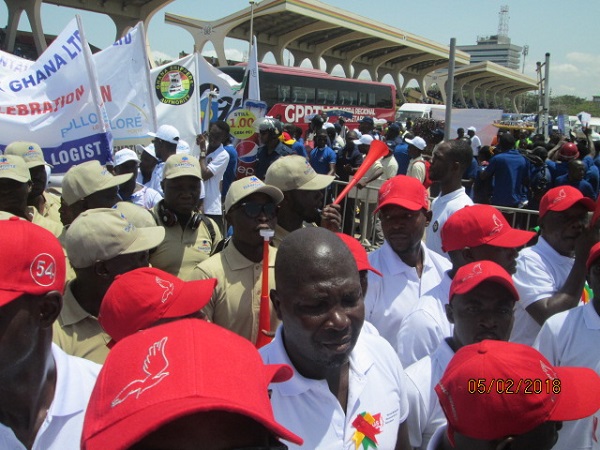
Ghana’s organised labour is striking a familiar but firmer tone this May Day, using the occasion to press home its long-standing demand for jobs, productive growth and stronger local participation in the economy.
In a statement issued by the Trades Union Congress Ghana to mark International Workers’ Day, and signed by its Secretary-General, the union’s 2026 theme — “Pivoting to Growth, Jobs and Sustainable Livelihoods Beyond Macroeconomic Stability” signals less of a departure and more of an escalation.
Same priorities, new urgency
For years, organised labour has argued that economic policy must be anchored on employment, industrial growth and local value creation. This year’s theme does not shift that position; it sharpens it.
What gives the message added weight is the current macroeconomic backdrop.
With inflation easing to 3.2% and broader indicators pointing to stabilisation, labour leaders are now challenging policymakers to demonstrate how these gains are improving real economic conditions.
The underlying question is straightforward: if stability is returning, where are the jobs?
Disconnect between recovery and reality
The TUC’s position reflects persistent concerns about the gap between headline economic improvements and lived experience.
Despite signs of recovery, many workers continue to grapple with unemployment, underemployment and weak purchasing power. In that context, the union argues that stabilisation while necessary has limited value if it does not translate into tangible benefits.
This disconnect forms the backbone of this year’s May Day message.
BOX: Jackson’s analysis echoes labour’s stance
The concerns raised by organised labour are reinforced by the views of Joe Jackson, who has been vocal about structural weaknesses in Ghana’s economy.
Jackson argues that the country’s challenges are often misread. Rather than a simple issue of trade imbalance, he points to persistent “value leakages” through profit repatriation, debt servicing and capital outflows, which erode the gains from exports.
In his assessment, this weakens the foundation of macroeconomic stability itself, since the economy struggles to retain the value it creates.
He is equally critical of the heavy policy focus on SMEs. While acknowledging their importance, he argues that most operate at low productivity levels and are largely survival-driven.
“If launching SME programs created growth, Ghana should be an economic superpower by now,” he notes.
Drawing comparisons with South Korea and Singapore, Jackson emphasises that sustained growth typically comes from a smaller pool of highly productive, scalable firms.
The implication aligns with labour’s concerns: without stronger domestic production and value retention, job creation will remain constrained.
Re-centering the growth model
Organised labour continues to advocate a policy mix that prioritises domestic production, industrial expansion and local ownership in key sectors.
There is also a renewed call for investment in agriculture, manufacturing and value-added exports, alongside measures to ease the cost of doing business and improve access to financing.
Importantly, the emphasis is not only on creating jobs but ensuring they are sustainable, fairly paid and capable of supporting long-term livelihoods.
Subtle pushback on stabilisation-led policy
Embedded in the theme is a critique of policy approaches that emphasise macroeconomic stabilisation, often linked to programmes backed by the International Monetary Fund without sufficient focus on structural transformation.
Labour’s argument is that while such measures can restore balance, they do not inherently build productive capacity or deliver inclusive growth.
From stability to transformation
As Ghana marks May Day, the debate is shifting from stabilisation to transformation.
For the Trades Union Congress Ghana, the issue is no longer whether macroeconomic conditions are improving, but whether those improvements are translating into jobs and better livelihoods.
That, ultimately, will be the real measure of economic progress.
In this light, the 2026 theme reads less like a policy pivot and more like a reminder: stability is only the starting point, the real work lies in turning it into broad-based prosperity.