Mission 300 Lights Up 50 Million Lives as Africa’s Electricity Drive Gains Momentum
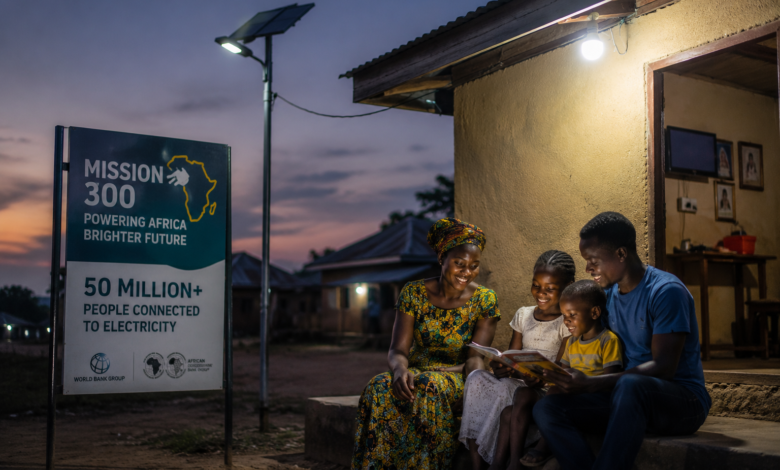
More than 50 million Africans have gained access to electricity in less than three years under Mission 300, a continent-wide initiative led by the World Bank Group and the African Development Bank (AfDB) aimed at connecting 300 million people to power by 2030.
The milestone marks a significant step in addressing one of Africa’s biggest development challenges, where more than 600 million people still live without electricity, limiting opportunities for education, healthcare, business and industrial growth.
According to the World Bank and the African Development Bank, the new connections are already transforming lives by enabling households to light their homes after dark, allowing health facilities to safely store vaccines, helping students study in the evenings and giving small businesses longer operating hours.
For millions of Africans, access to electricity represents far more than switching on a light. It improves healthcare, creates jobs, supports businesses, enhances education and raises living standards.
“Behind that number are households with lights on after dark, health clinics able to refrigerate vaccines, small businesses able to extend their working day, and students able to study in the evening. This is what progress looks like — and it is just the beginning,” the two institutions said in a joint statement.
Faster Pace of Electrification
Mission 300 was launched in 2023 to accelerate electricity access across Africa by coordinating investments, financing, policy reforms and partnerships rather than relying on a single project.
Since the initiative began tracking results in July 2023, electrification has accelerated significantly.
The World Bank said projects it finances connected about 12 million people to electricity during the initiative’s first year. By April this year—before the fiscal year had even ended—that figure had risen by another 20 million people.
Similarly, the African Development Bank reported that its electricity projects have reached 5.2 million people in less than two and a half years, compared with 9.6 million people connected over the previous eleven years.
Officials say the figures demonstrate that reforms and coordinated implementation are beginning to deliver results much faster than before.
More Than Infrastructure
Unlike traditional infrastructure programmes, Mission 300 combines financing with policy reforms designed to remove longstanding bottlenecks in Africa’s power sector.
So far, 36 African countries have adopted national energy compacts aimed at improving planning, attracting investment and accelerating electricity delivery.
The initiative also brings together governments and development partners including The Rockefeller Foundation, the Global Energy Alliance for People and Planet and Sustainable Energy for All (SEforALL), among others.
Countries Showing Strong Progress
Among the strongest performers is Tanzania, where nearly eight million people have been connected to electricity through rural electrification programmes. Approximately five million of those connections have been recorded since Mission 300 began.
Nigeria has also made significant progress, connecting approximately 4.5 million people through a combination of grid improvements, solar home systems and mini-grid projects.
Other countries recording substantial gains include Niger, Uganda, Senegal, Sierra Leone, Angola, Guinea-Bissau and Mozambique.
According to the World Bank and AfDB, these examples demonstrate that countries can significantly accelerate electricity access when financing, government reforms and implementation work together.
Why Electricity Matters
Access to reliable electricity remains one of Africa’s biggest barriers to economic transformation.
Without electricity, businesses struggle to operate efficiently, schools cannot effectively support learning after dark, hospitals face challenges in delivering quality healthcare, while communities remain excluded from opportunities created by the digital economy.
Development experts argue that expanding electricity access is critical for industrialisation, job creation, food processing, digital services and broader economic growth.
A Long Road Ahead
Although reaching 50 million new connections represents an important milestone, the challenge remains substantial.
Mission 300 aims to provide electricity to 300 million Africans by the end of the decade, requiring sustained investment, policy reforms and effective implementation across the continent.
The World Bank and African Development Bank expressed confidence that the initiative is on the right trajectory, noting that all reported connections are independently verified through government agencies, utilities, project implementation teams and private operators to ensure transparency and accountability.
“The goal of 300 million people connected by 2030 remains ambitious. But the trajectory is clear, the methodology is sound, and the results are real. Mission 300 is working and the momentum it has built is changing lives across Africa,” the statement concluded.