
GH¢14.5bn in Dividends: Ghana’s Stock Market Delivers Big Returns to Investors
Ghana Stock Exchange-listed companies paid GH¢14.5 billion in dividends from January 2025, while the benchmark index recorded a 352% cumulative return between January 2024 and September 2026, highlighting the market’s growing appeal to investors.

Investors in Ghana’s listed companies have received approximately GH¢14.5 billion in dividends since January 2025, while the stock market’s benchmark index has recorded a cumulative return of 352% over a longer period, according to Ghana Stock Exchange (GSE) Managing Director Abena Amoah.
The figures highlight the returns available in Ghana’s equities market and offer a measure of the opportunities the domestic capital market can provide to investors seeking alternatives to traditional savings and fixed-income products.
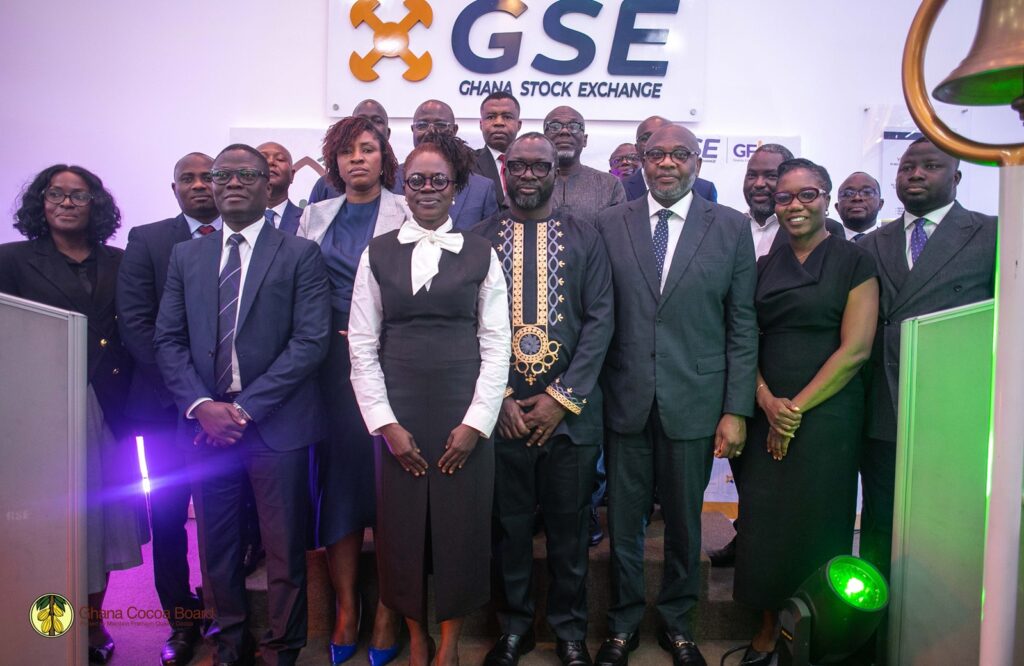
Presenting the figures at the listing ceremony for Cocoa Capital PLC’s Commercial Paper and Notes Programme on the Ghana Fixed Income Market (GFIM), Ms Amoah said the GSE Composite Index recorded the cumulative return between January 2024 and September 2026.
The dividend payments, meanwhile, cover the period from January 2025 to October 2026, according to her address.
The performance places the stock exchange’s recent activity in focus at a time when the market is also attracting capital for businesses and institutions, including the cocoa sector’s latest effort to finance purchases through domestic investors.
Returns put the spotlight on equities
Dividend payments provide investors with income from companies in which they hold shares, while movements in share prices can generate capital gains when investments appreciate in value.
The GH¢14.5 billion dividend figure therefore points to a substantial flow of income to investors registered in Ghana, although it does not establish how much the average investor received or how widely the payments were distributed.
The GSE Composite Index’s reported 352% cumulative return also signals strong appreciation in the market over the period covered. However, the index return and dividend payments measure different things and should not be added together as if they represent a single return for every investor.
Actual investment outcomes depend on the shares purchased, their prices at the time of purchase and sale, dividends received, transaction costs and the length of time an investor holds the investment.
The distinction matters because a strong overall market performance does not mean every listed company has delivered similar returns or that every investor has benefited equally.
Nevertheless, the figures provide evidence that Ghana’s equities market can offer opportunities for both income and capital growth.
Market performance remains subject to fluctuations
The strong cumulative performance also needs to be considered alongside shorter-term movements in share prices.
The GSE Composite Index fell by 6.20% in September 2026, closing at 14,141.56 points, although it retained a year-to-date return of 61.24% at the end of the month, according to the exchange’s September market report. <Cite refs={[“turn759730search1″,”turn759730search7”]}/>
The monthly decline illustrates why investors must distinguish between longer-term market gains and the possibility of losses over shorter periods.
Share prices respond to corporate earnings, investor expectations, economic conditions and changes in the availability and cost of capital. Dividend payments can also change depending on company performance and decisions by boards and shareholders.
For investors, the implication is that headline returns should be considered alongside the risks associated with individual securities, the quality of corporate disclosures and the financial health of listed companies.
For the GSE, sustaining confidence will depend not only on attracting investors during periods of strong performance but also on ensuring that market participants have access to reliable information and understand the risks involved.
Investor participation is expanding
Ms Amoah also reported that investor accounts at the Central Securities Depository increased from 1.5 million in December 2024 to 1.8 million in September 2026.
The increase points to a growing pool of registered investors and provides another indication of expanding participation in Ghana’s securities market.
However, the number of accounts does not necessarily represent the number of active investors, the value of investments held or the distribution of market participation across income groups.
Broadening access will require more people to understand how securities work, how to evaluate investment risks and how to make informed decisions based on their financial circumstances.
To support that effort, the GSE is preparing to introduce the GSE Academy, which Ms Amoah said would help companies become investment-ready, strengthen investor relations and improve public understanding of investment products and risks.
The initiative is also intended to help prospective issuers understand the requirements for accessing capital markets, potentially widening the range of businesses able to raise funds through the exchange.
Capital market growth extends beyond share trading
The dividend figures formed part of a broader account of the GSE’s activity since January 2025.
Ms Amoah said Ghana’s public capital markets had mobilised approximately GH¢6.79 billion for businesses and institutions through equity and debt instruments during the period. The activity included three initial public offerings, one rights issue, eight corporate bond issuances and two commercial paper transactions.
The latest addition is Cocoa Capital PLC’s commercial paper programme, under which the first tranche raised GH¢3.39 billion to support cocoa purchases for the 2026/2027 season.
The transaction demonstrates that the domestic market can provide financing beyond conventional share offerings, giving institutions access to debt instruments that can meet specific funding needs.
For investors, such instruments may provide additional choices, although the risks and potential returns differ from those associated with shares. For issuers, they can offer another route to raising funds from domestic sources.
Ms Amoah said the GSE hoped the Cocoa Capital transaction would encourage more public and private sector institutions to consider raising money locally for commercially viable activities.
She also emphasised the importance of corporate governance, timely disclosure and compliance with continuing listing obligations, particularly for institutions raising funds from investors.
Sustaining confidence will be critical
The latest figures present a picture of a stock market that has delivered significant dividends, recorded strong cumulative index gains and expanded its pool of investor accounts.
But the longer-term value of these developments will depend on whether companies can sustain their financial performance, investors can make informed decisions and the market can continue attracting businesses seeking capital.
For Abena Amoah and the GSE, the task is to build on the reported gains while strengthening the systems that underpin investor confidence.
The exchange’s challenge is not simply to attract more money into the market. It is to ensure that investors have credible opportunities, issuers meet their obligations and the capital raised supports productive economic activity.
The reported returns offer a compelling reason for investors to pay attention to Ghana’s equities market. Sustaining that interest will require transparency, sound corporate governance and a clear understanding that past performance does not guarantee future returns.