US$300,000 Flood Relief Signals Growing Role of Faith-Based Organisations in Ghana’s Disaster Response
As Ghana grapples with increasingly frequent and destructive flooding, faith-based organisations are emerging as important partners in strengthening the country’s disaster response capacity, complementing government efforts with humanitarian support that reaches vulnerable communities quickly.
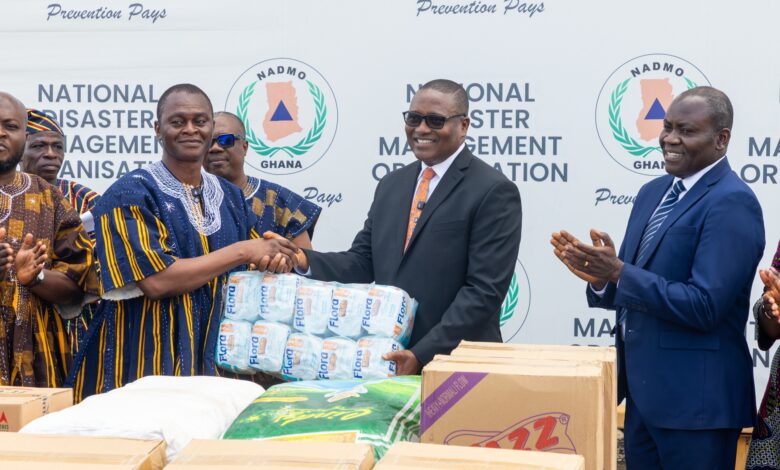
The latest example came on Wednesday when the Africa West Area Presidency of The Church of Jesus Christ of Latter-day Saints donated humanitarian relief items valued at approximately US$300,000 to the National Disaster Management Organization (NADMO) to support victims of the recent floods that affected parts of the country.
The donation, presented at NADMO’s headquarters in Accra, includes food supplies, clean water, mattresses, blankets, mosquito nets and hygiene products intended to provide immediate relief to displaced families.
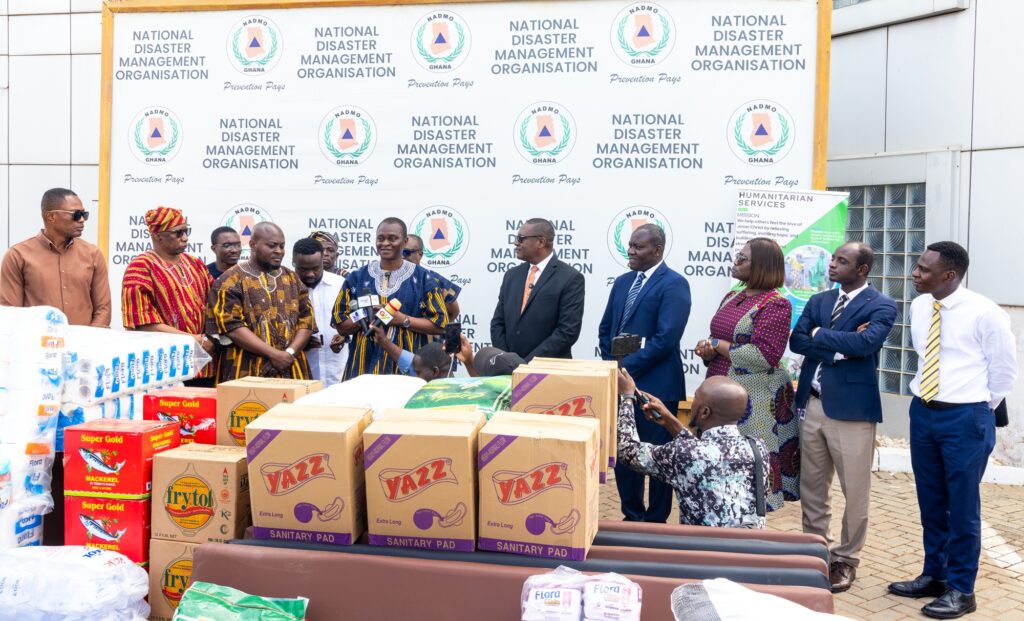
The items comprise 2,000 bags of rice, 1,000 boxes of cooking oil, 500 boxes of canned fish, 100 large sacks each of maize and gari, 2,000 bags of sachet water, 5,000 blankets, 5,000 mosquito nets, 5,000 student mattresses, 1,000 packs of toilet rolls, 200 boxes of sanitary pads and 200 boxes of baby diapers.
NADMO said the supplies will be distributed to flood victims within the Greater Accra Metropolitan Area, while additional consignments have been allocated to Wassa Amenfi East in the Western Region and the Dosukorpe community in the Anloga District of the Volta Region following requests for assistance.
Speaking during the presentation, Elder Adeyinka A. Ojediran, General Authority Seventy of The Church of Jesus Christ of Latter-day Saints, said the donation reflects the Church’s commitment to serving vulnerable communities through practical humanitarian action.
“Our faith teaches us to love our neighbors and serve those in need, and this donation is an expression of that discipleship,” he said.
He noted that the floods had left many families without basic necessities and stressed the importance of restoring dignity and hope through timely assistance.
“We urge that these items be used to bless the lives of those most affected. May they bring relief, comfort and renewed strength. We reaffirm our commitment to continue working with NADMO and the Government of Ghana to support communities in times of need,” he added.
Beyond the emergency donation, the Church also called for stronger public commitment to environmental cleanliness and responsible waste management to reduce the risk of future flooding.
As part of that effort, it announced that members across Africa will participate in the annual All-Africa Service Project on August 15, 2026, dedicating at least three hours to community service activities including clean-up exercises, tree planting and other environmental improvement projects.
Receiving the items on behalf of NADMO, Director-General Major (Rtd) Dr. Joseph Bikanyi Kuyon described the Church as one of the organisation’s longstanding humanitarian partners.
“The Church of Jesus Christ of Latter-day Saints has been a consistent partner in supporting Ghana’s disaster management efforts. This is not the first time they have come forward to assist communities in need; their compassion and commitment to humanitarian service continue to make a meaningful difference,” he said.
He noted that responding effectively to disasters increasingly requires strong collaboration between government institutions, development partners and civil society organisations.
“In times of emergencies, effective response requires collaboration among government institutions, partners and communities. We appreciate the Church’s willingness to support and for responding swiftly to the needs of people affected by these unprecedented floods,” Dr. Kuyon added.
The latest intervention comes as Ghana continues to confront the growing economic and humanitarian costs of recurring floods, with policymakers increasingly emphasising that disaster resilience requires not only emergency relief but also stronger partnerships among government, the private sector, development organisations and faith-based institutions.