
Ghana’s Banks Urged to Prepare for Virtual Assets as AI Reshapes Financial Services
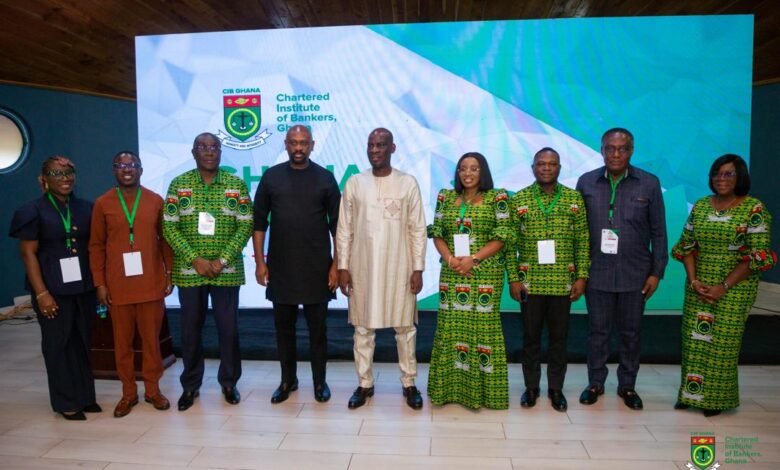
Ghana’s banking industry is being urged to strengthen its capacity to adopt virtual assets and artificial intelligence as emerging technologies reshape financial services and introduce new risks to traditional banking operations.
The Chartered Institute of Bankers, Ghana (CIB Ghana) says banks must invest in professional competence, ethical standards and technological capacity to remain competitive while safeguarding public trust.
The call was made at the Institute’s 30th National Banking and Ethics Conference, held from November 9 to 10 at Aqua Safari Resort in Ada, where industry leaders highlighted the need for stronger cybersecurity, improved fraud detection and greater accountability in the adoption of emerging technologies.
Held under the theme, Banking on the Future: Trust, Technology and Transformation, the conference brought together bank chief executives, board chairs, regulators, policymakers and other industry professionals. It was the first time the annual event had been held outside Accra in its 30-year history.
Banks face pressure to embrace virtual assets
Chief Executive Officer of Npontu Technologies, Dr Stephane Nwolley, challenged banks to begin developing their virtual assets capabilities or risk losing ground as financial services evolve.
He warned that traditional banks could repeat the experience of the mobile money revolution if they failed to respond early to emerging technologies.
“If we do not take time, that which happened to mobile money would happen to us. Is doing nothing an option?” he asked.
He proposed a 90-day action plan for bank boards and executives, beginning with the appointment of an executive responsible for virtual assets, an assessment of regulatory requirements and the development of a pilot product with a licensed or sandboxed virtual asset provider.
The Ghana Association of Banks (GAB) Chief Executive Officer, Mr John Awuah, also announced that the association and CIB Ghana were developing a virtual assets certification programme to strengthen bankers’ knowledge and professional capacity.
“Virtual assets have come to stay, and we have to participate and know everything about it, because it is the next frontier of banking,” he said.
Minister calls for review of banking legislation
The Minister for Education, Haruna Iddrisu, who opened the conference, invited CIB Ghana to submit proposals for reviewing the legal framework governing the banking profession.
He pledged to forward the recommendations to the Minister for Finance, saying the review should consider how banking legislation could strengthen public trust, promote ethical technology adoption and make financial services more responsive to customers.
He also advocated integrating financial literacy into basic education, describing loan default as a breach of trust.
“My first recommendation is for you to advise the government, and we’re happy to do so, to integrate financial literacy into basic foundational learning. Default, in my view, means betrayal of trust,” he said.
Cybersecurity and ethics remain critical
The Governor of the Bank of Ghana, Dr Johnson Pandit Asiama, whose address was delivered by the Director of Communications, Mr Bernard Otabil, cautioned banks against allowing technological innovation to undermine the principles of integrity, accountability and financial stability.
“Innovation should advance the interests of customers and the economy, but it must not weaken the principles of integrity, accountability, and financial stability,” he said.
CIB Ghana President, Dr Ellen Ohene-Afoakwa, identified fraud, cyber threats and unethical conduct as major challenges requiring collective action across the banking industry.
She said the Institute would strengthen professional standards, research and its contribution to banking policy, while upgrading its digital and physical infrastructure.
“Our collective fight against fraud, cyber threats and unethical behaviour is key to building public trust in the banking system and the economy,” she said.
The conference’s masterclasses also highlighted weaknesses in the industry’s response to cybercrime, particularly the limited sharing of intelligence among financial institutions.
Ms Audrey Mnisi Mireku of the Ghana Association of Banks said inadequate information-sharing was allowing cybercriminals to exploit weaknesses across the financial system.
“The reason today cyber criminals are able to defraud one person all the way to the bank is because we do not share intelligence,” she said.
Discussions also examined board-level responsibility for cybersecurity, employee controls and the need for human oversight in AI-driven fraud detection.
Board Chairman of Fidelity Bank Ghana, Mr James Reynolds (Jim) Baiden, stressed the importance of competence and independence in board appointments, warning against selecting directors based on personal relationships rather than professional qualifications.
CIB Ghana prepares for 2028 world conference
CIB Ghana is also preparing to host the World Conference of Banking Institutes (WCBI) in Accra in 2028, an event expected to attract approximately 1,500 delegates from across the world.
Chief Executive Officer of the Institute, Mr Robert Dzato, said the event would be formally launched in the first quarter of 2027.
He called on banks and other industry stakeholders to support the preparations, describing the conference as an opportunity to showcase Ghanaian and African banking expertise internationally.
“The business of banking is trust. That is the currency in banking, really. And that trust comes from the character, competence and conduct of bankers,” he said.
The conference underscored the need for Ghana’s banking industry to match technological advancement with professional competence, sound governance and ethical conduct as financial services become increasingly digital.