Guterres Backs Africa’s Push to Rewrite Global Finance Rules
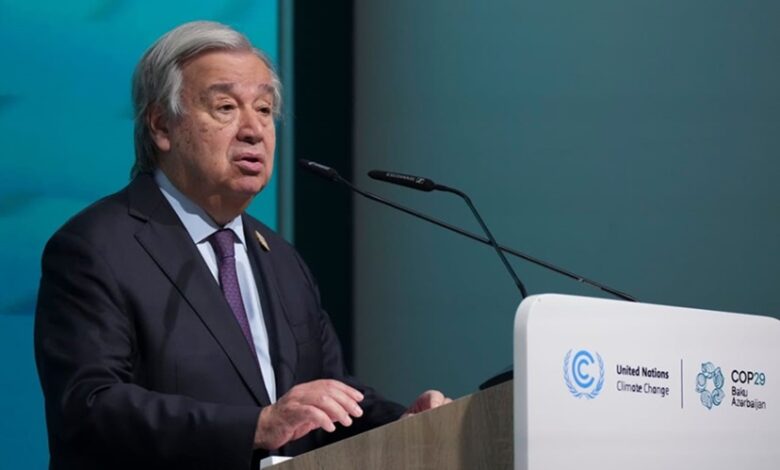
Africa’s growing demand for a fairer global financial system took centre stage in Nairobi on Tuesday as United Nations Secretary-General António Guterres declared that the continent is no longer waiting for solutions from the developed world but is increasingly shaping the global economic reform agenda itself.
Addressing the opening ceremony of the Africa Forward Summit hosted by William Ruto and attended by Emmanuel Macron, Guterres said Africa was demonstrating leadership at a time of deep global instability, particularly in areas such as debt reform, climate justice, development financing, and international tax cooperation.
“The name of this summit captures the moment and the mission — Africa Forward,” Guterres told delegates, describing the continent as a force increasingly driving global conversations on economic governance rather than remaining a passive participant.
His remarks come amid growing frustration across developing economies over what many leaders describe as an outdated international financial architecture that continues to disadvantage African countries through high borrowing costs, weak representation in decision-making institutions, and unequal access to development finance.
Guterres argued that the current global financial system, largely designed after the Second World War, no longer reflects modern economic realities and continues to perpetuate structural inequalities against Africa.
“A global system designed without Africa — and still largely operating without Africa — is perpetuating century-old injustices,” he said.
The UN chief pointed to several African-led initiatives that are increasingly influencing international economic reform discussions, including the Borrowers’ Platform, which seeks to strengthen the collective negotiating power of indebted countries, and ongoing efforts to challenge international credit rating systems that many African governments believe unfairly inflate borrowing risks and financing costs.
He also praised African countries for their role in advancing the Sevilla Commitment, which seeks to expand the lending capacity of multilateral development banks, mobilise larger volumes of private capital, and provide relief for debt-stressed developing economies.
The speech placed particular emphasis on the growing push for African financial self-determination, with Guterres commending efforts led by the African Development Bank to mobilise African resources for African development priorities.
He further highlighted Africa’s role in pushing for a United Nations Framework Convention on International Tax Cooperation aimed at reducing illicit financial flows and ensuring countries retain greater shares of domestic revenues.
“I want to praise African leaders that have understood that it is absolutely essential to mobilise a much stronger share of natural resources in order to accelerate the development of the continent,” he stated.
Climate finance and energy inequality also featured prominently in the address.
Guterres said Africa continues to suffer disproportionately from climate change despite contributing minimally to global emissions, warning that the continent faces mounting economic and social pressures from rising temperatures, food insecurity, and energy volatility.
He noted that Africa possesses about 60 percent of the world’s best solar potential but attracts only two percent of global clean energy investment.
According to him, with adequate financing, Africa could generate ten times more electricity than it requires by 2040 entirely from renewable sources.
Yet, he observed, nearly 600 million Africans still lack access to electricity while one billion people continue to rely on unsafe cooking fuels, contributing to approximately 800,000 deaths annually, particularly among women and children.
The Secretary-General argued that the continent’s high borrowing costs remain one of the biggest barriers to development, with African countries on average paying interest rates roughly twice as high as OECD economies.
“That is not a market verdict on Africa. It is a verdict on the injustices of the system,” he stressed.
Guterres also turned attention to Africa’s vast reserves of critical minerals needed for the global energy transition, warning against a continuation of historical extraction patterns in which raw materials are exported while value creation occurs elsewhere.
He called for fairer mineral value chains that prioritise in-country processing, manufacturing, environmental standards, transparency, and meaningful economic benefits for local communities.
“For too long, Africa’s resources have been extracted, the value captured elsewhere, and the environmental damage left behind,” he said.
The remarks are expected to resonate strongly across African economies currently seeking greater control over natural resource revenues, energy transition financing, and industrial development strategies.
The Africa Forward Summit is focusing heavily on economic transformation, climate finance, global governance reform, and strengthening Africa’s role within international decision-making institutions.