
AfCFTA Chief Warns Africa’s $3.4 Trillion Single Market Risks Failure Without Strong Competition Rules
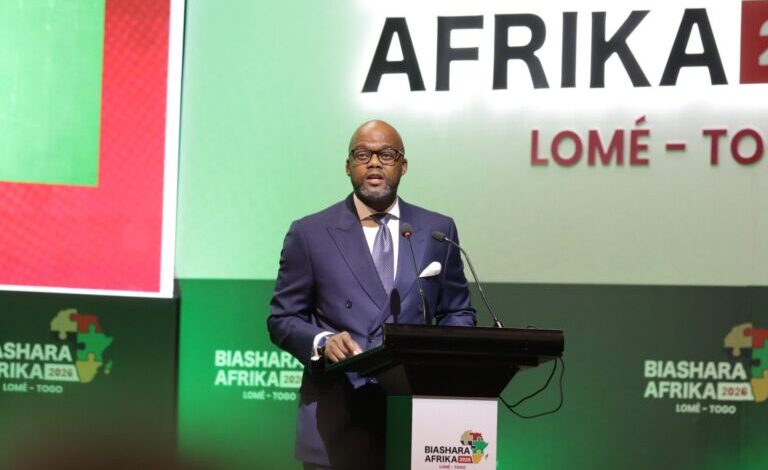
The African Continental Free Trade Area’s ambitious push to create a unified $3.4 trillion market could fail to deliver meaningful economic integration unless African governments confront monopolies, cartel behavior and fragmented regulation across the continent, AfCFTA Secretary-General Wamkele Mene has warned.
Speaking at the Biashara Afrika conference, Mene said Africa’s trade integration agenda risks becoming “incomplete” if policymakers focus narrowly on tariff reductions while ignoring the deeper structural reforms required to build fair and competitive markets.
“If we have open borders but allow cartels to partition markets behind those open borders, we will not succeed,” Mene told delegates, as he mounted one of the strongest defenses yet of the AfCFTA’s proposed continental competition regime.
His remarks underscore a growing realization within the AfCFTA Secretariat that tariff liberalization alone will not automatically unlock intra-African trade unless governments simultaneously address anti-competitive practices, transport costs, logistics inefficiencies and regulatory fragmentation.
The comments come as African governments accelerate efforts to operationalize the AfCFTA, a trade bloc spanning 1.4 billion people and expected to become the world’s largest free trade area by membership.
Mene argued that competition policy has now become as important to Africa’s integration agenda as trade policy itself.
“What we didn’t understand in 2010 about the importance of competition policy and other policy enablers in an integrated market has become even clearer today,” he said.
The AfCFTA chief revealed that when negotiations began more than a decade ago, many African negotiators questioned why a competition protocol was necessary within a free trade agreement. That skepticism, he suggested, has since given way to concerns that dominant firms could undermine market integration by squeezing out smaller entrants even after tariffs are removed.
The warning is particularly significant for sectors such as aviation, digital commerce, logistics and transport, where market concentration and high operating costs remain major barriers to cross-border trade.
Mene pointed specifically to Africa’s transport and logistics systems as a critical vulnerability for the continent’s integration ambitions, warning that high costs in those sectors could erode the benefits of tariff-free trade if not properly regulated.
He also flagged mounting concerns around the digital economy, where African policymakers are increasingly wary of allowing large technology platforms to dominate emerging continental digital markets without oversight.
The AfCFTA Secretariat is now moving toward the establishment of a continental competition authority and tribunal under the trade pact — an institution Mene said would function independently while coordinating with national and regional regulators.
The proposal, however, has not been without resistance.
Mene disclosed that some African stakeholders had pushed back strongly against elements of continental integration, saying he was surprised by “the commitment of some Africans to fragmentation” and the desire to preserve what he described as a “colonial economic model.”
Still, he said the AfCFTA ultimately prevailed by assuring member states that the continental framework was designed to complement — not replace — national competition authorities.
The broader objective, he argued, is political as much as economic.
“We are not looking to replace national or regional authorities,” Mene said. “What we are looking to do is to advance Pan-Africanism, to make it a reality and not a slogan.”
The AfCFTA Secretariat is now studying aspects of the European Union’s decades-long experience in market integration as it develops Africa’s own continental competition architecture.
For African businesses, the outcome of those discussions could shape the future operating environment across industries ranging from manufacturing and aviation to e-commerce and logistics.
The bigger challenge for policymakers, Mene acknowledged, will be balancing competition enforcement with Africa’s industrialization ambitions.
“How do we make sure,” he asked, “that we are not inadvertently compromising our development policy space?”