Oyster Agribusiness Honours Farmers, Expands Value Chain Push
Oyster Agribusiness has reaffirmed its commitment to strengthening Ghana’s agricultural value chain, recognising more than 40 farmers at its 2026 Farmers’ Durbar while outlining an ambitious expansion strategy focused on productivity, diversification and value addition.
Held in Kintampo, the annual durbar brought together over 650 farmers, development partners and municipal officials, underscoring the central role of smallholder farmers in driving food security and economic growth. The event, a key component of the company’s farmer engagement strategy, aims to motivate producers while rewarding excellence across farming categories.
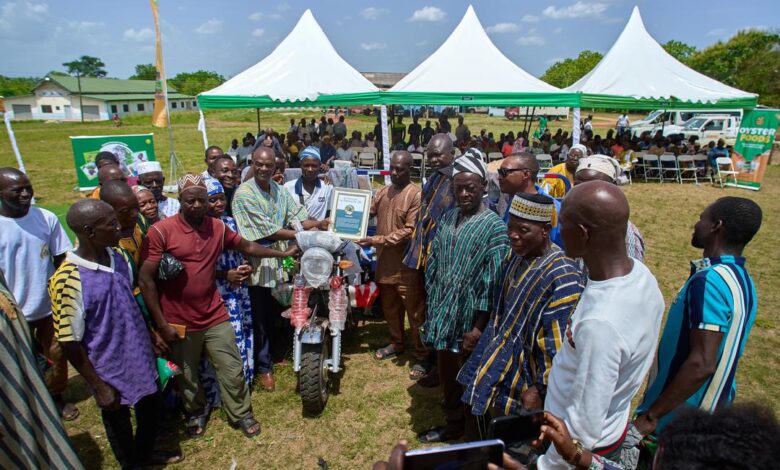
At this year’s ceremony, 12 farmers were honoured as top performers for the 2024 and 2025 cropping seasons. Awards ranged from tricycles and motorbikes to deep freezers, planters, fertiliser applicators and knapsack sprayers, alongside agrochemicals. In a strong signal of inclusivity, persons with disabilities also received targeted support, including wheelchairs.
For the 2024 season, Nana Edmund A. Kandituo of Kyinya emerged as Overall Best Farmer after producing 246 bags of sorghum. Tiwaa Felicia of Kobeda No. 2 was named Best Female Farmer, while Haruna Duut, also of Kobeda No. 2, was adjudged Best Farmer with Disability with a yield of 68.4 bags. Likpaam Mamey recorded the highest yield per acre at 27.72 bags.
In the 2025 season, Mohammed Ahmed of Kawanpe took the top honour with 304 bags, while Dora Yeboah of Bantama was named Best Female Farmer with 94.16 bags. Ibrahim Ibn-Iddrisu of Kadelso won Best New Farmer with 190.38 bags. Other awardees included Kofi Mwene (Best Youth Farmer), Jaboni Ninboti (Best First Season Farmer), Diekuu Alosius (Best Farmer with Disability) and Alice Ankomah, who achieved the highest yield per acre.
Chief Executive Officer Elizabeth Bidzakin said the company’s growth reflects a deliberate strategy that combines input support, climate-smart training and guaranteed market access.
“Our approach is to build a resilient and inclusive agricultural ecosystem where farmers are not only supported to produce but are assured of markets and opportunities to increase their incomes,” she said, adding that women, youth and persons with disabilities remain central to programme design.
She revealed that Oyster Agribusiness is broadening its focus beyond staple crops into vegetable farming, poultry, livestock and aquaculture—sectors she described as critical to job creation and long-term sustainability. The company is also deepening value addition, processing products such as tuo zaafi flour, peanuts, gari and melon seeds to unlock higher market value.
The company’s footprint continues to expand. Currently operating in 10 districts in Bono East, Oyster Agribusiness has extended its activities to the Ejura-Sekyedumase and Mampong municipalities in the Ashanti Region, supporting about 30,000 farmers annually.
Growth in participation has been rapid. From just 64 farmers cultivating 182 acres in 2022, the programme expanded to 192 farmers on 1,600 acres in 2023, and 1,409 farmers across 5,000 acres in 2024. By 2025, participation had risen to 2,470 farmers cultivating 8,129 acres across 10 districts. The momentum has continued into 2026, with support already extended to 120 communities and about 2,500 farmers registered to cultivate nearly 10,000 acres during the major rainy season.
Bono East Regional Director of the Ministry of Food and Agriculture, James Adu, commended the company’s contribution, describing it as a “yeoman’s service” to smallholder development. He indicated that the Ministry would integrate the company’s activities into its monitoring framework to promote modern and sustainable farming practices.
“As we celebrate the dedication of our farmers, it is important that all stakeholders strengthen collaboration to address persistent challenges including market access, infrastructure gaps and climate risks,” he said.
Kintampo Municipal Director of Agriculture Eric Kontomah echoed the call for stronger partnerships, stressing that sustained agricultural growth depends on coordinated support across the value chain. He reaffirmed the Directorate’s commitment to extension services, input access and capacity building, particularly for young farmers.
On behalf of the Kintampo Municipal Chief Executive, Coordinating Director Johnson Nyarko highlighted the company’s role in addressing long-standing market constraints that have historically led to post-harvest losses and low farmgate prices.
Beneficiary farmers also shared testimonies of impact. Gifty Awuni from Nyamebekyere said her yields and income had improved significantly since joining the programme in 2023, while Haruna Duut noted that increased production had enabled him to better support his family and fund his children’s education.
Representatives from development partners, including IDH, RDF LBG, the Ghana Climate Innovation Centre and Calli Ghana Ltd, joined traditional leaders and local officials at the durbar, reinforcing the growing collaboration driving Ghana’s agricultural transformation.