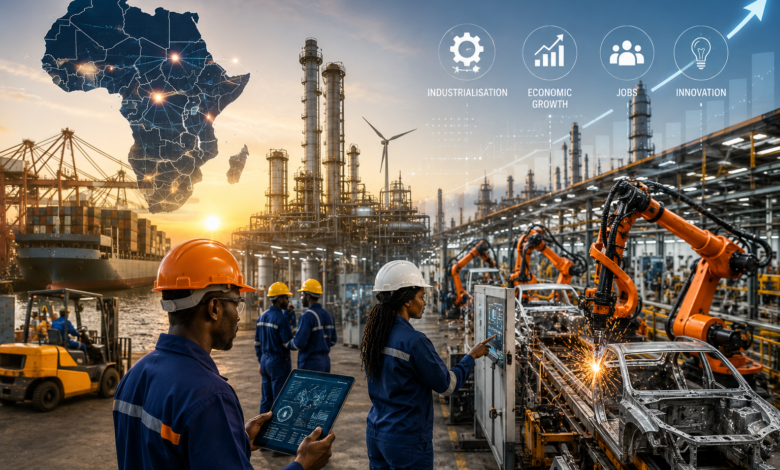
Africa’s industrialisation ambitions are being sharply reframed, as a new continental assessment finds that only a handful of economies are structurally equipped to sustain high-growth transformation.
The 2025 RED Index of Industrial Development in Africa, released by the Business Council for Africa, identifies Morocco, Egypt, South Africa and Mauritius as the only countries with the structural alignment required to drive long-term industrial expansion at scale.
The finding underscores a broader reality: industrialisation on the continent is less a question of intent and more a function of underlying economic architecture.
Structure, Not Ambition, Defines Outcomes
The RED Index argues that while many African countries have articulated industrialisation strategies, few possess the foundational conditions needed to execute them effectively.
It evaluates economies across three core pillars:
- Engines of Industrialisation — the foundational capabilities such as infrastructure, human capital and industrial base
- Accelerators — factors that influence the speed of transformation, including investment flows and policy execution
- Decelerators — structural constraints that can stall progress, notably corruption and security instability
Across much of the continent, these decelerators continue to outweigh the drivers of growth, weakening institutional effectiveness and slowing the implementation of industrial policy.
Leaders, Emerging Contenders and Laggards
While the four leading economies demonstrate strong alignment across all three pillars, others are still in transition.
Countries such as Rwanda and Nigeria are highlighted as showing “meaningful progress,” but remain incomplete in their industrial trajectory. Meanwhile, the majority of African economies fall into “Vulnerable” or “Stalled” categories, reflecting persistent structural gaps.
The report suggests that without deliberate reforms to address these constraints, industrialisation efforts risk remaining fragmented and unsustainable.
Lessons from Global Industrial Success
The Index draws on the historical experiences of countries such as South Korea, Malaysia, Vietnam and Brazil, alongside African examples like Morocco and Ethiopia, to identify what drives successful transformation.
A consistent pattern emerges: sustained industrial growth depends on coordinated policy execution, strong institutions, and long-term investment in productive capacity.
This positions the RED Index not merely as a ranking tool, but as a framework for policy design and strategic decision-making.
A Call for Ownership and Execution
In a foreword to the report, Aliko Dangote, President and Chief Executive of the Dangote Group, stressed the need for internal leadership in Africa’s development.
“Africa’s development cannot be imported or outsourced. It must be built, owned, and sustained from within,” he said, emphasising the importance of structural clarity and disciplined execution.
Echoing this, Arnold Ekpe, Chairman of the Business Council for Africa, described the findings as a turning point.
“This is not just an index. It is a call to action for African policymakers, investors, and businesses to take ownership of Africa’s industrial future,” he noted.
Implications for Investment and Policy
At a time when global investors are searching for scalable and resilient growth opportunities, the Index offers a clear lens on where industrialisation is most viable — and where risks remain elevated.
For policymakers, the message is equally direct: industrial transformation will require more than policy declarations. It will demand structural reform, institutional discipline, and sustained commitment to execution.
As Africa seeks to reposition itself within global value chains, the gap between ambition and structure may ultimately determine which economies succeed — and which remain on the margins of industrial growth.