
Why Is Growth Not Creating Jobs? TUC Questions Ghana’s Economic Gains at May Day 2026
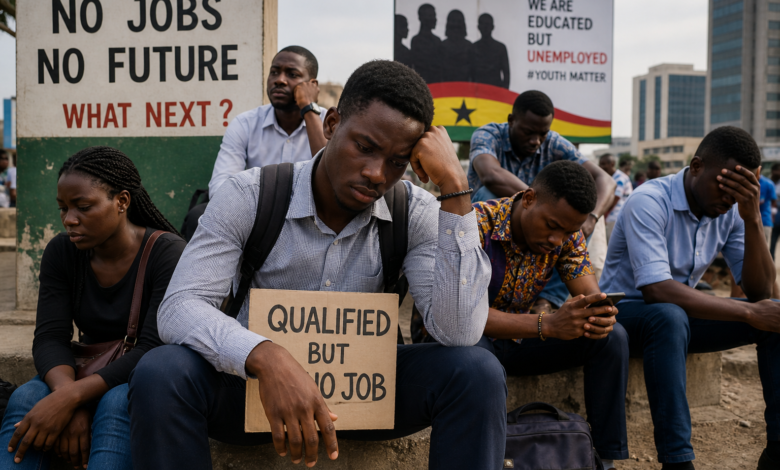
“Why does an economy that has been growing consistently for more than three decades fail to create enough good jobs for its people? How do we explain the contradiction of a robust economy unable to provide quality employment?”
These were the pointed questions posed by Secretary-General of the Trades Union Congress Ghana, Joshua Ansah, as organised labour challenged the real impact of Ghana’s economic progress at the 2026 May Day celebration.

Speaking on the theme “Pivoting to Growth, Jobs and Sustainable Livelihoods Beyond Macroeconomic Stability,” Mr. Ansah acknowledged recent gains in macroeconomic performance but warned that they have not translated into meaningful improvements in employment and livelihoods.
Strong Indicators, Weak Employment Outcomes
Ghana is currently recording some of its most stable macroeconomic indicators in decades. Inflation has dropped to 3.2 percent as of March 2026, the lowest level since the 1960s, while the cedi has strengthened significantly against major international currencies.
Yet, according to organised labour, these gains mask a deeper structural problem.
“There is hardly any evidence that GDP growth has created decent employment in Ghana,” Mr. Ansah said, pointing to a growing disconnect between economic expansion and job creation.
He argued that Ghana’s so-called strong macroeconomic indicators have largely excluded employment, raising concerns about the inclusiveness of the country’s growth model.
Growth Without Inclusion
Mr. Ansah described the current trajectory as one where economic growth is not sufficiently benefiting the workforce.
“Economic growth without jobs is exclusion. Stability without livelihoods is incomplete,” he stated.
He warned that an economy that expands while workers remain insecure cannot be considered to have achieved its broader social purpose.
While acknowledging that growth has generated some level of employment, he emphasised that the response has been weak and insufficient relative to the needs of the population.
Quality of Jobs in Question
A major concern highlighted by the TUC is the quality of jobs being created. Mr. Ansah noted that many of the available opportunities are low-paying and insecure, forcing workers to accept them due to limited alternatives.
“The few jobs that have been created are of low quality. People undertake such activities primarily because their options are limited,” he explained.
This trend, he suggested, reflects a labour market under strain, where the absence of decent work is pushing many into vulnerable and informal employment.
A Structural Disconnect
At the heart of the TUC’s argument is what it describes as a contradiction within Ghana’s economic framework. Despite more than three decades of consistent growth, the economy has not been able to generate sufficient quality jobs for its growing labour force.
This disconnect, Mr. Ansah implied, points to deeper structural issues in the way growth is generated and distributed.
Call for a Policy Reset
Organised labour is therefore calling for a shift in policy direction, in line with the 2026 May Day theme, to ensure that economic growth is directly linked to job creation and improved livelihoods.
The TUC maintains that employment must become a central pillar of economic policy, rather than an assumed by-product of growth.
For Mr. Ansah, the challenge ahead is clear. Ghana must move beyond celebrating macroeconomic stability and focus on building an economy that delivers decent jobs, fair incomes and sustainable livelihoods.
Until then, he suggests, the country’s economic success will remain incomplete.