Camelot Puts Sustainability at Heart of Next Growth Phase
Camelot Ghana Plc is beginning a phased shift towards more sustainable production as the listed security printing and manufacturing company seeks to align its next phase of growth with changing environmental standards and responsible manufacturing practices.
The company plans to move its cheque and certificate stock towards FSC-certified and recycled-content paper, replace conventional inks with low-VOC, water-based alternatives, and begin systematically tracking energy consumption across its flexographic printing operations.
Camelot is also working towards a formal sustainability policy and reporting structure aligned with Ghana Stock Exchange disclosure requirements, signalling a move to make environmental performance part of its mainstream business reporting.
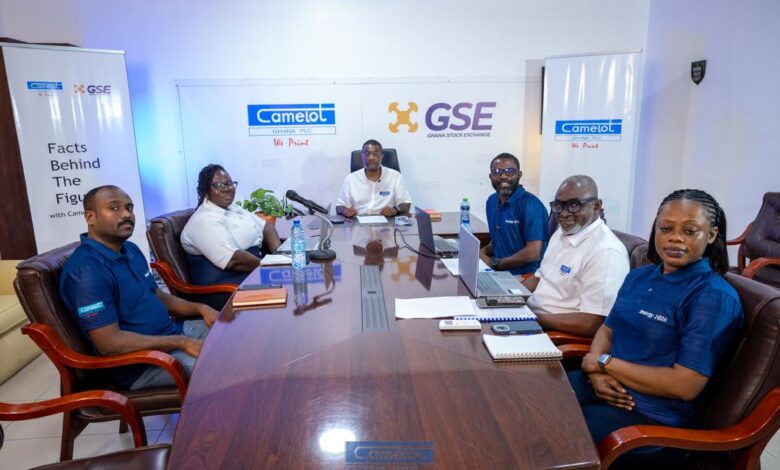
The company disclosed the plans during its “Facts Behind the Figures” investor engagement with the Ghana Stock Exchange, where it outlined its financial performance, sustainability priorities, workforce development and growth strategy.
Managing Director of Camelot Ghana, John Villars, said the company was seeking to build sustainability into how it sources materials and produces its products rather than treating it as an add-on to its business.
The first steps are already underway, with the company conducting supplier certification mapping as well as an audit of ink use and energy consumption.
Linking growth to responsible production
The sustainability push comes as Camelot expands beyond its traditional computer paper and cheque printing business into flexographic label printing, web offset printing, document security solutions and verification software.
Its Flexo business has become a major driver of that expansion, growing by 321% cumulatively between 2022 and 2025 and increasing its contribution to total revenue from 23% to 34%.
For a manufacturing company experiencing rapid growth in this area, managing the environmental footprint of production could become increasingly important.
Tracking energy consumption, reducing the use of higher-impact inks and increasing the use of certified and recycled paper could help Camelot better understand and manage the environmental costs associated with its expanding operations.
The phased approach also allows the company to build sustainability considerations into procurement and production decisions without attempting to change its entire operating model at once.
Investing in people
Camelot’s development strategy extends beyond environmental sustainability to its workforce.
The company reported an employee retention rate of 99%, significantly above the manufacturing-sector benchmark of about 72% to 74%. Retention among critical and skilled employees stands at 95%, compared with a benchmark of 82% to 90% for skilled trades.
Camelot also said it promotes about 10% of its workforce internally, above the approximately 6% manufacturing benchmark, while spending the equivalent of 5% of revenue on learning and development.
The company’s gender balance across its workforce stands at 45%, compared with a 30% print-industry benchmark, although women account for 27.27% of management positions.
Camelot has set a target of achieving 50% overall workforce gender balance and at least 30% representation at management level.
These investments are particularly significant for Ghana’s manufacturing sector, where the availability of skilled technical workers remains important to productivity, innovation and the ability of local companies to compete in increasingly sophisticated markets.
Growth broadens beyond traditional printing
The sustainability and workforce initiatives are being pursued alongside a significant expansion of Camelot’s business.
Total revenue rose to GH¢36.97 million in 2025, representing a 31.5% increase over the previous year and continuing a four-year growth trajectory from GH¢13.41 million in 2022.
The expansion has been broad-based.
Flexo revenue increased by 321% cumulatively between 2022 and 2025, while revenue from the company’s cheque business increased by 140% over the same period.
Traditional business revenue also grew by 102%.
The faster expansion of Flexo has changed the company’s revenue mix, but Camelot said this has not resulted from a collapse in its traditional businesses.
The stronger performance has also helped restore the company’s financial position, with shareholders’ funds moving from a negative position in 2022 to GH¢6.83 million in 2025.
Growth continues, but at a slower pace
The momentum has continued into 2026, although at a more moderate rate.
Camelot reported first-half turnover of GH¢21.40 million, representing a 9% increase over the same period in 2025.
Profit after tax rose by 19% to GH¢2.61 million, while the profit margin improved to 12%, its highest half-year level over the period reviewed.
The slower revenue growth follows two consecutive years in which first-half turnover increased by 72%, suggesting the company is now expanding from a significantly larger revenue base.
Building the next phase
Camelot’s next phase of growth will focus on expanding capacity for its Flexo business while pursuing opportunities in digital printing and developing artificial intelligence applications for its operations and the wider printing sector.
The company also plans to pursue printing opportunities with state institutions and agencies, intensify market research and product development, and increase employee training and engagement.
For Ghana, the significance of Camelot’s strategy extends beyond the performance of one listed company.
The combination of manufacturing expansion, technical skills development, local production and more responsible use of resources points to the type of industrial growth that can create economic value while responding to increasingly important environmental and governance expectations.
The company’s challenge now is to ensure that its sustainability ambitions keep pace with its commercial expansion.
If successfully implemented, Camelot’s phased approach could provide a practical example of how Ghanaian manufacturers can integrate environmental responsibility, workforce development and business growth into a single strategy rather than treating sustainability as a separate corporate initiative.