The Forgotten Fleet: How Kwame Nkrumah’s Historic Vehicles Could Drive Ghana’s Heritage Tourism
By: Charles C. Moncar
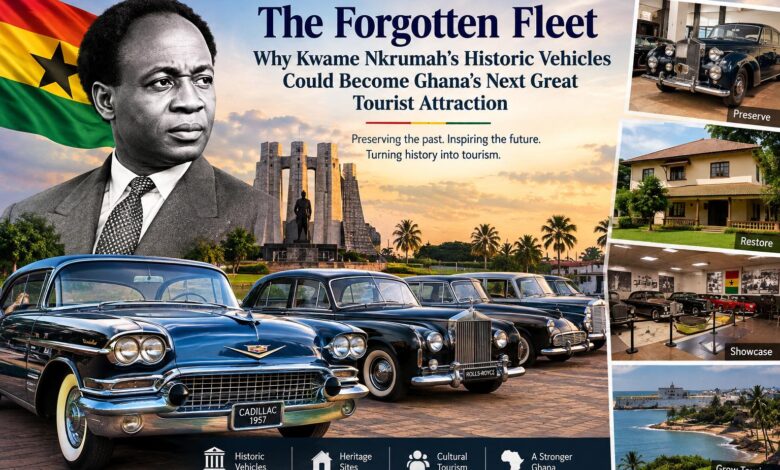
When Ghana became the first sub-Saharan African nation to break free of colonial rule in 1957, the cars that carried its first leader through the streets of Accra were more than transportation. They were rolling symbols of a new nation stepping onto the world stage. Nearly seven decades later, several of those same vehicles sit quietly decaying in storage yards and museum car parks, largely unseen by the public they once represented. For a country with a growing appetite for cultural tourism, that neglect looks less like history fading away and more like an opportunity waiting to be claimed.
Why Kwame Nkrumah’s Vehicles Matter to Ghana’s History
Dr. Kwame Nkrumah led Ghana to independence in 1957, having served as Prime Minister from 1952, and went on to become the country’s first President. He is widely regarded as the architect of Ghana’s founding and one of the most influential voices of the Pan-African movement, a legacy that still shapes how the continent thinks about unity and self-determination. The vehicles associated with his presidency were not simply personal possessions. They ferried him to independence ceremonies, state functions, and diplomatic engagements at a moment when Ghana was demonstrating to the world that African nations could govern themselves with dignity and style. That context is what turns a garage full of old cars into a genuine piece of national heritage.
The Historic Vehicles Associated With Kwame Nkrumah
Several vehicles have been linked to Nkrumah’s era, though the documentation behind each varies and, in some cases, remains incomplete.
- 1957 Cadillac Series 62 (Ocean Blue/Black).Accounts describe an ocean-blue 1957 Cadillac 62 series as one of the presidential vehicles Nkrumah used from 1957 until his overthrow in 1966. A separate Cadillac, reported to have been manufactured by General Motors and reinforced for security in Bulgaria, is said to have been Nkrumah’s first official vehicle as Prime Minister; it reportedly disappeared for decades before being rediscovered near Nkawkaw around 2021 and returned to the National Museum, where it now sits in the car park.
2 & 3. Rolls-Royce Phantom III and Phantom V Limousine. Multiple reports place a Rolls-Royce among Nkrumah’s official vehicles, with one currently held under the custody of Ghana’s State Protocol rather than on public display. Specific model details for the Phantom variants are harder to independently confirm, so any claim about exact years or configurations should be treated cautiously until verified through archival or museum records.
- Cadillac Fleetwood Series 75.Described as a vehicle used for ceremonial parades and state functions, the Fleetwood is often cited as one of the more elegant cars in the presidential fleet, chosen for its size and presence at official engagements.
- ZIS/ZIL Limousinesand 6. GAZ-13 Chaika.These Soviet-built limousines are occasionally mentioned in connection with Nkrumah’s era, reflecting Ghana’s diplomatic ties with the Eastern Bloc during the Cold War years. Verified details about their specific use remain limited in publicly available sources.
- Mercedes-Benz vehicles.Nkrumah’s connection to Mercedes-Benz extends beyond his presidency. After the 1966 coup that removed him from power, he lived in exile in Conakry, Guinea, where President Ahmed Sékou Touré reportedly provided him with a Mercedes-Benz for transport, since Nkrumah never successfully learned to drive himself. Other Mercedes vehicles from the period have also surfaced in garage footage circulating in recent years.
- Humber sedans.Humbers are associated with the broader fleet of official cars used by Ghana’s early government, consistent with the British-era vehicles common in West African motor pools of that period.
A Heritage Collection at Risk
The condition of these vehicles has become a recurring public concern. In footage that circulated recently, a visitor touring a storage garage documented Mercedes-Benz and Rolls-Royce vehicles reportedly linked to Nkrumah and other former heads of state, their bodywork dust-covered and worn from years of apparent neglect. According to the individual who recorded the video, the cars appeared to have been sitting largely untouched, and he appealed directly to the government to intervene. Separately, one of the Cadillacs long associated with Nkrumah has been photographed at the National Museum showing visible rust and deterioration. Of the vehicles publicly discussed, only one is understood to have undergone restoration, and even that car reportedly can no longer be driven under its own power. These are observations drawn from public reporting and citizen accounts rather than independently verified museum assessments, but the pattern they describe is consistent: valuable historical assets sitting exposed to the elements with no coordinated preservation plan.
Restoring the Cars Could Create a New Tourism Attraction
A properly restored fleet of presidential vehicles would offer something few African destinations can currently provide: a tangible, driveable link to the independence era. Visitors already travel to see historic aircraft, ships, and state cars in museums around the world precisely because these objects make history physical. A Ghanaian equivalent, built around Nkrumah’s cars, would give both domestic and international visitors a reason to linger longer in Accra and in the Western Region, translating directly into museum admissions, guided tours, and spending on local hospitality.
Why Government Funding and Preservation Matter
Restoring vehicles of this age and rarity requires specialized skills that are not always available locally. One reasonable path forward would be a dedicated government budget line for historic vehicle preservation, potentially including arrangements to send individual cars abroad to specialists experienced in restoring mid-century Cadillacs, Rolls-Royces, and Soviet-era limousines, before returning them to Ghana for permanent display. This kind of investment would not be unprecedented; heritage vehicle restoration is a recognized field internationally, with institutions in the United States and elsewhere maintaining historic government and ceremonial vehicles as part of broader public history efforts.
From Forgotten Vehicles to a Heritage Museum
A secure, climate-controlled facility purpose-built for these vehicles, rather than an open car park or an unmonitored garage, would protect them from further deterioration while making them genuinely accessible. Ghana already has a foundation to build on: a glass-walled structure at the Kwame Nkrumah Memorial Park in Accra was completed some years ago specifically to house one of the presidential vehicles, suggesting the idea of a dedicated display space is not new. Expanding this concept into a fuller heritage museum, one that brings together the fleet, contextual exhibits, and trained guides, would convert scattered artifacts into a coherent visitor experience.
Nkrumah’s Homes and Other Historical Sites
The vehicles are only part of a wider preservation story. Nkrumah’s birthplace and childhood home in Nkroful, in the Western Region, has been the subject of community-led renovation efforts, including local fundraising to restore what residents describe as his maternal home. Further afield, his residence in Conakry, Guinea, known as Nkrumah Villa or Villa Syli, where he lived during his years in exile and wrote several of his major political works, has reportedly become the subject of a formal preservation initiative, with the Ghanaian government engaging Guinean authorities about renovating and converting the property into an accessible heritage site. Taken together with the Kwame Nkrumah Mausoleum in Accra, these sites form a geographic trail across two countries that heritage tourism could eventually connect.
A Wider Opportunity for African Heritage Tourism
Ghana is not alone in facing this challenge. Historic vehicles and artifacts connected to other African leaders and traditional rulers, including a car once linked to the Asantehene Otumfuo Agyeman Prempeh I now reportedly deteriorating at a museum in Kumasi, face similar risks of neglect. A more deliberate, continent-wide approach to cataloguing and preserving such objects could position African heritage tourism as a serious complement to the continent’s natural and wildlife attractions, giving travelers additional reasons to explore its political and cultural history alongside its landscapes.
Preserving History for Future Generations
The vehicles that once carried Kwame Nkrumah through the early years of Ghana’s independence are still here, even if they are not yet in the condition their history deserves. What they need now is not sentiment but commitment: dedicated funding, professional restoration, and a museum setting where they can be seen rather than stored. Done well, this would not only honor a defining chapter of Ghana’s past, it would give the country a heritage attraction few others can match, and give the next generation of Ghanaians a chance to stand beside the very cars that carried their nation into independence.