Ghana’s Blue Economy at Crossroads: New Study Calls for Urgent Reforms in Boatbuilding Skills
A new study on boat and shipbuilding skills development has called for urgent policy action to prepare the country for the opportunities emerging from the blue economy.
The study, initiated by the Ghana Employers’ Association (GEA) and Confederation of Danish Industry (DI), acknowledges the growing importance of Ghana’s marine space to fisheries, inland water transport, coastal livelihoods, trade, tourism, job creation and industrial development.
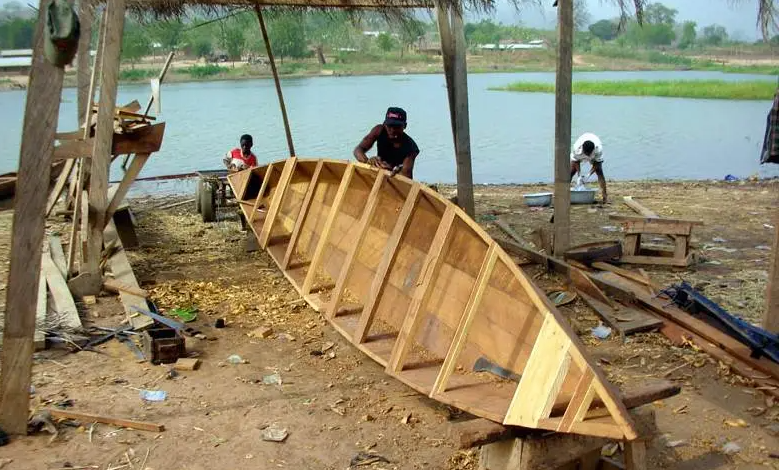
The report indicates that although Ghana has strong traditions in canoe and boatbuilding, the sector is constrained by outdated tools, weak formal training systems, limited marine-specific curricula, poor certification pathways for informal artisans and inadequate Industry-TVET collaboration. Interviews and surveys were conducted with government agencies, TVET actors, marine industry players, tutors, artisans and other relevant stakeholders to understand the skills gap and propose reforms.
One of the central findings is that Ghana’s boatbuilding workforce is still largely informal, with many artisans acquiring skills through apprenticeship and indigenous knowledge transfer. While this practical experience remains valuable, the study warns that the absence of formal certification limits employability, productivity, safety compliance and transition into modern marine manufacturing.
The study found strong demand for composite/fiberglass boat construction, marine welding and fabrication, marine electrical and electronics systems, refrigeration, digital marine systems, automation and 3D modelling. It further identifies additional priority areas, including marine mechanics and fitting, marine painting and surface finishing, marine communication and navigation systems, carpentry and joinery for boatbuilding, production and workshop management, craftsmanship and technical skills development as well as marine navigation and engineering modules.
The findings also show that many existing TVET programmes are too generic for the needs of the marine sector. Although welding, fabrication, mechanical engineering, electrical engineering and carpentry provide useful foundations, they do not sufficiently address boat design, marine-grade fabrication, composite and fiberglass molding, marine safety, corrosion control, digital systems, environmental management and vessel maintenance. The report therefore argues that Ghana cannot build a competitive blue economy without a workforce trained for the realities of modern boat and shipbuilding.
The report identifies demand across artisanal fisheries, inland water transport, tourism and eco-marine tours, government and emergency services, and potential regional markets. This makes boatbuilding reform not only an education matter, but also an industrial, employment, trade and coastal livelihood agenda.
The research points to a changing sector. Traditional wooden canoe production remains important, but pressure on timber resources and the growth of modern marine operations are creating demand for fiberglass, aluminum, composite materials and digital technologies. This shift requires new training models that blend classroom learning, practical attachment, modern workshop tools and industry mentorship.
To close the skills gap, the report recommends the introduction of at least six-month modular short courses in boatbuilding and marine operations, with 30 per cent classroom-based theory and 70 per cent industry attachment. These courses should target workers at National Proficiency Levels I and II and National Certificate Levels I and II under the national TVET qualification framework.
The study also calls for Recognition of Prior Learning systems to assess and certify experienced informal workers such as canoe builders, welders, carpenters, plumbers, mechanics and boat repairers. This, it says, will help transform existing practical knowledge into recognized qualifications and open pathways to decent work, entrepreneurship and formal employment.
On curriculum development, the report proposes a practical process that begins with occupational standards and continues through standard validation, unit specification, learning materials, assessment guidelines and quality editing. This approach is expected to ensure that new courses are industry-responsive, competency-based and useful to both formal learners and informal artisans.
On policy, the report recommends a national mandate for marine-specific curriculum modules, the creation of Marine TVET Innovation Hubs in coastal regions, investment in modern laboratories and workshops, trainer upskilling, industry-led curriculum co-creation, employment mapping and public-private partnerships for skills development. It also urges inclusive training for women, youth and persons with disabilities through flexible modules, local-language instruction where necessary, accessible facilities and targeted career promotion.
The initiative by GEA and DI is therefore timely and relevant. By bringing this research into the Ghanaian policy space, the two institutions have provided evidence that can guide government, the Commission for Technical and Vocational Educational Training (CTVET), the Ghana Maritime Authority, TVET institutions, industry associations and private investors in building a skills ecosystem for the marine economy.
The report concludes that Ghana’s boatbuilding sector can become a major driver of employment, innovation and sustainable industrial growth if policy reforms are matched with practical training, certification, modern infrastructure and stronger collaboration between industry and training institutions.