
The Insurance Imperative: Safeguarding Africa’s Single Market under AfCFTA
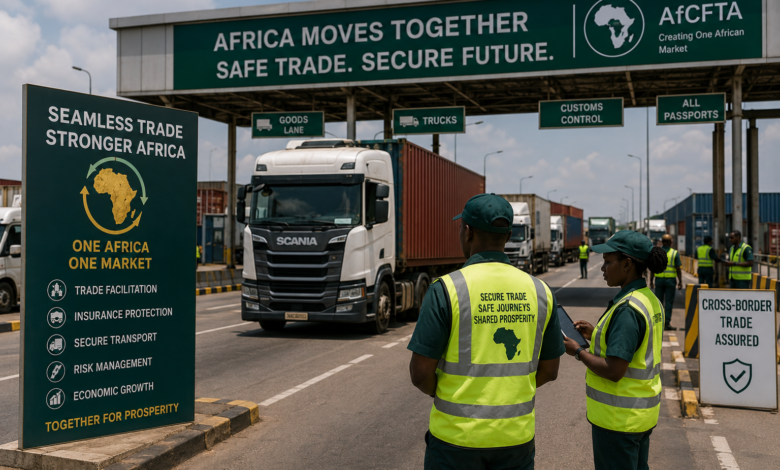
By Dr. Winfred Kwasi Dodzih
The African Continental Free Trade Area (AfCFTA) represents one of the most transformative economic initiatives of the twenty-first century. More than a trade agreement, it is a bold blueprint for redefining Africa’s economic future by creating a single, integrated market capable of unlocking the continent’s immense productive capacity and accelerating sustainable development.
Bringing together 54 signatory countries and 47 ratifying State Parties, the AfCFTA is the world’s largest free trade area by the number of participating countries. It encompasses a market of more than 1.5 billion people with a combined Gross Domestic Product (GDP) exceeding US$3.4 trillion, presenting an unprecedented opportunity to stimulate investment, expand manufacturing, strengthen regional value chains and position Africa as a more competitive player in the global economy.
Since the commencement of preferential trading in January 2021, important progress has been made. The AfCFTA Guided Trade Initiative has demonstrated the practical viability of cross-border commerce under the Agreement, while negotiations on digital trade, investment, competition policy and intellectual property continue to deepen the institutional foundations of Africa’s single market. Development institutions estimate that, if fully implemented alongside complementary reforms in transport, logistics and customs administration, the Agreement could increase intra-African trade by more than 50 per cent over the coming decade, lift millions of Africans out of poverty and create significant new employment opportunities, particularly for young people and women entrepreneurs.
Yet the promise of AfCFTA extends beyond the removal of tariffs. A truly integrated continental market depends upon the safe and predictable movement of people, goods, services and capital across national borders. This remains one of Africa’s greatest challenges.
Persistent infrastructure deficits, fragmented regulatory frameworks, cumbersome border procedures, currency volatility, high logistics costs and limited access to affordable trade finance continue to constrain cross-border commerce. Equally concerning are recurring incidents of xenophobia and social tensions in some parts of the continent, particularly attacks targeting African migrants and traders in South Africa, which have periodically undermined business confidence and highlighted the disconnect between the aspirations of economic integration and the realities experienced by those who trade across borders.
These challenges expose an important gap in Africa’s integration architecture. While significant attention has rightly been devoted to tariff liberalisation, customs modernisation and trade facilitation, comparatively little emphasis has been placed on protecting the traders, transport operators, investors and businesses whose daily activities sustain continental commerce.
This is where insurance assumes strategic importance.
A harmonised African Trade and Mobility Insurance Framework could become one of the missing pillars of AfCFTA implementation by providing seamless protection for cross-border commercial activities, reducing risk, strengthening investor confidence and enhancing the resilience of regional supply chains. Rather than creating an entirely new institutional model, Africa already possesses a proven foundation in the ECOWAS Brown Card Insurance Scheme, which for decades has facilitated cross-border motor insurance protection and claims settlement across West Africa.
Expanding the principles underpinning the ECOWAS Brown Card into a broader continental framework would represent a practical and achievable step towards safeguarding traders, commercial vehicles, goods in transit and business mobility throughout Africa. By complementing the objectives of the AfCFTA with a harmonised insurance ecosystem, the continent would not only promote freer trade but also foster greater confidence, legal certainty and economic security for all who participate in Africa’s growing single market.
As Africa moves from negotiating agreements to implementing integration, the success of the AfCFTA will depend not merely on how effectively borders are opened, but on how safely and confidently Africans can cross them to trade, invest and build shared prosperity.
- The African Continental Free Trade Area in Context
The African Continental Free Trade Area was formally launched in 2018 and began trading operations in 2021. It is one of the flagship projects of the African Union under Agenda 2063.
Key objectives include:
- Eliminating tariffs on most goods traded between African countries
- Reducing non-tariff barriers such as customs delays and quotas
- Promoting industrialisation through regional value chains
- Enhancing the free movement of goods, services, capital and eventually people
- Increasing Africa’s share of global trade, currently below 20 percent of total African commerce
Recent projections by development institutions suggest that successful implementation could boost intra-African trade by over 50 percent by 2035 if supported by infrastructure and policy alignment.
- Benefits of the Continental Free Trade Framework
The potential gains from the agreement are wide-ranging and multidimensional.
2.1 Economic Expansion
- Expansion of market access for small and medium enterprises
- Increased export diversification beyond raw materials
- Greater industrial production within African economies
- Improved competitiveness of African goods globally
2.2 Employment and Skills Development
- Creation of new manufacturing and logistics jobs
- Expansion of cross border entrepreneurship
- Skills transfer through regional industrial clusters
2.3 Consumer Welfare
- Reduced prices due to tariff elimination
- Wider availability of goods and services
- Improved product variety across markets
2.4 Regional Stability and Cooperation
- Strengthening of diplomatic relations through economic interdependence
- Reduction of trade related conflicts
- Enhanced policy coordination among member states
- Opportunities Emerging from AfCFTA Implementation
The agreement creates significant structural opportunities for Africa’s future growth.
3.1 Industrial Value Chains
- Automotive assembly hubs in North and Southern Africa
- Agro-processing corridors in West and East Africa
- Pharmaceutical production zones to reduce import dependency
3.2 Digital Trade Expansion
- Growth of e-commerce platforms operating across borders
- Mobile payment interoperability across African financial systems
- Expansion of fintech solutions for trade financing
3.3 Infrastructure Development
- Continental rail and road corridor expansion
- Modernisation of ports and customs systems
- Logistics hubs linking landlocked economies to coastal trade routes
- Threats and Structural Risks to Success
Despite optimism, several risks could undermine the effectiveness of the agreement.
4.1 Policy Fragmentation
- Inconsistent tariff enforcement across member states
- Slow ratification of key protocols
- Protectionist tendencies in domestic industries
4.2 Infrastructure Gaps
- Poor road and rail connectivity between regions
- High transportation costs across borders
- Inefficient customs processing systems
4.3 Currency and Financial Instability
- Exchange rate volatility
- Limited cross-border payment systems
- Weak trade finance access for small traders
4.4 Social and Political Risks
- Periodic xenophobic incidents in South Africa disrupt foreign traders’ confidence
- Political instability in parts of the continent
- Informal border tensions and migration pressures
The xenophobic episodes in South Africa, particularly those recorded in 2019 and recurring sporadically in later years, have had psychological and economic impacts on cross-border traders from Nigeria, Zimbabwe, Somalia and other African states. These events highlight the gap between policy ambition and social cohesion on the ground.
- Africa’s Readiness for a Safe Continental Trading Environment and a Call for a Harmonised African Trade and Mobility Insurance Scheme
The success of the African Continental Free Trade Area (AfCFTA) depends not only on reducing tariffs but also on protecting the people, goods, investments, and businesses that drive intra-African trade. As traders, entrepreneurs, transport operators, and travellers move more freely across borders, Africa needs a harmonised continental trade and mobility insurance scheme that provides seamless coverage across member states.
Such a scheme would protect cargo in transit, cross-border businesses, commercial vehicles, health emergencies, travel disruptions, and trade-related risks under a single, mutually recognised framework. It would reduce the cost and complexity of purchasing multiple national insurance policies, strengthen confidence in cross-border commerce, improve risk management, and support small and medium-sized enterprises that form the backbone of Africa’s economy.
Governments, regulators, insurers, development finance institutions, and the private sector should collaborate to establish an African Trade and Mobility Insurance Framework aligned with AfCFTA. A unified insurance ecosystem would not only safeguard continental trade but also accelerate investment, enhance financial inclusion, and reinforce Africa’s journey toward a truly integrated, resilient, and competitive single market.
For AfCFTA to succeed, it must go beyond tariff reduction and address trader safety and mobility assurance.
5.1 Current Strengths
- Existence of regional economic communities such as ECOWAS, SADC and EAC
- Established cross-border trade corridors
- Growing digital identity and payment systems in several countries
- Increasing political commitment to integration
5.2 Key Weaknesses
- Limited harmonisation of insurance systems
- Weak enforcement of trader protection laws
- Insufficient cross-border dispute resolution mechanisms
- Lack of unified risk coverage for travelling traders
- The Case for a Continental Insurance Framework
A critical but often overlooked enabler of trade is insurance. The expansion of the ECOWAS Brown Card Insurance Scheme provides a model for scaling protection across Africa.
Originally designed to cover motor vehicle third party liability within West Africa, the scheme demonstrates how regional insurance cooperation can reduce risk and increase mobility.
6.1 Proposed Continental Expansion Benefits
- Protection for traders transporting goods across borders
- Reduction of financial loss from accidents or cargo damage
- Improved confidence for small scale cross border traders
- Faster dispute resolution across jurisdictions
6.2 Key Features of a Harmonised African Trade Insurance Scheme
- Continental third party motor insurance coverage
- Cargo and goods in transit protection
- Standardised claims processing across borders
- Digital insurance verification systems
- Integration with customs clearance platforms
6.3 Institutional Requirements
- Coordination between the African Union and regional blocs
- Legal harmonisation of insurance regulations
- Digital infrastructure for real time policy verification
- Capacity building for insurers and regulators
- Strengthening Trust in Intra African Trade
For AfCFTA to achieve its full potential, trust must become a central currency of trade.
- Trust between governments through policy alignment
- Trust between traders through legal protection
- Trust between citizens through social cohesion
- Trust in systems through transparent dispute resolution
Addressing xenophobia is not only a moral imperative but also an economic necessity. Trade integration cannot flourish where traders fear physical insecurity or discrimination in key markets.
Conclusion
The African Continental Free Trade Area represents a historic opportunity to redefine Africa’s economic trajectory. Its promise of a unified market, industrial growth and expanded trade is within reach, but only if structural barriers are addressed.
The persistence of social tensions, particularly xenophobic incidents in South Africa, highlights the need for deeper integration that goes beyond policy declarations. Economic integration must be matched with social protection and cross-border security.
A continental insurance framework, built upon the foundation of systems like the ECOWAS Brown Card Insurance Scheme, offers a practical pathway to safeguard traders, reduce risk and strengthen confidence in African markets.
Ultimately, Africa’s trade future will not be determined only by agreements signed in summit halls, but by the safety, trust and predictability experienced by the ordinary trader moving goods from one border to another.