
Africa’s US$712 Billion Digital Economy Will Depend on One Thing: Can Countries Deliver on AfCFTA Commitments?
Africa’s ambition to build a single digital market worth an estimated US$712 billion by 2050 will depend less on new agreements and more on whether governments can implement a series of practical reforms that make cross-border digital trade faster, cheaper and more secure.
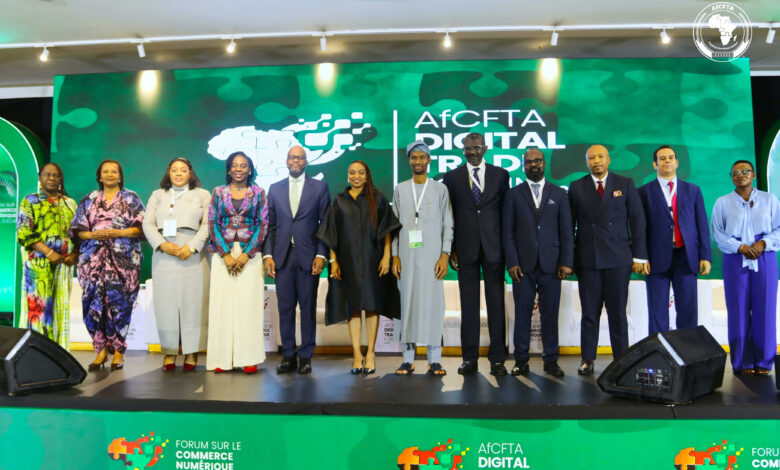
That was the central message from the Second AfCFTA Digital Trade Forum in Lagos, where African trade ministers, regulators, technology companies, investors and development partners agreed on eight priority actions aimed at translating the African Continental Free Trade Area’s Digital Trade Protocol into tangible economic opportunities for businesses.
The meeting marked an important shift for the AfCFTA. After years of negotiating rules governing digital trade, policymakers are now turning their attention to implementation, recognising that the success of Africa’s digital economy will ultimately be judged by how easily businesses can trade across borders.
The Forum, held under the theme “Digital Trade for a Connected African Market,” concluded with a roadmap calling on member states to accelerate ratification of the Digital Trade Protocol, expand digital infrastructure, modernise customs systems, strengthen cybersecurity, improve digital inclusion and create seamless cross-border payment systems.
For businesses, the implications extend beyond technology.
Efficient digital payments, harmonised regulations, trusted data governance and paperless trade systems are expected to reduce the cost of doing business across Africa while making it easier for companies to access customers in multiple markets under the AfCFTA.
One of the biggest barriers to intra-African trade has long been the complexity and cost of moving money across borders.
The Forum therefore renewed support for the Pan-African Payment and Settlement System (PAPSS), which enables businesses to settle cross-border transactions in local currencies, reducing dependence on third-party currencies while lowering transaction costs and settlement times.
Delegates also emphasised the need for greater investment in digital public infrastructure, including digital identity systems, broadband connectivity and online public services, arguing that these foundations are essential if Africa is to build a truly integrated digital marketplace.
Recognising that digital transformation must extend beyond large corporations, participants placed women, young entrepreneurs, micro, small and medium-sized enterprises (MSMEs) and rural communities at the centre of implementation efforts.
The AfCFTA Secretariat highlighted progress under its AfCFTA Digital Inclusion and Entrepreneurship Programme (ADIEP), implemented in partnership with Google, which is providing digital trade training to 7,500 SMEs across 19 African countries. The programme focuses on cross-border digital commerce, cloud technologies for small businesses and the productive use of digital tools to improve enterprise competitiveness.
The Forum also produced a concrete commercial outcome.
The AfCFTA Secretariat signed a Memorandum of Understanding with Quest Ghana Limited to establish a Digital Trade Corridor that will facilitate, monitor and settle cross-border trade transactions in line with AfCFTA regulations.
Speaking at the closing session, AfCFTA Secretary-General Wamkele Mene said digital trade should no longer be viewed as a future aspiration but as a practical tool for integrating more Africans into the formal economy.
He said harmonised regulations, trusted cross-border data flows, stronger digital infrastructure and improved skills development would determine whether Africa captures the full value of its expanding digital economy.
“We are ready to take responsibility for our own destiny as Africans to advance Africa’s digital economy with the support of our partners across the world,” he said.
Nigeria’s Minister of Industry, Trade and Investment, Dr. Jumoke Oduwole, who chairs the AfCFTA Council of Ministers Responsible for Trade, reaffirmed her country’s commitment to advancing implementation of the Digital Trade Protocol, describing digital integration as central to Africa’s broader economic transformation.
Ultimately, delegates agreed that Africa’s digital ambitions will depend not on the existence of continental agreements alone, but on how quickly governments translate them into national laws, modern digital infrastructure and business-friendly reforms that enable enterprises to trade seamlessly across the continent.