
Dubai Chambers Meets GNCCI, GIPC and Importers Association to Strengthen Ghana Trade Ties
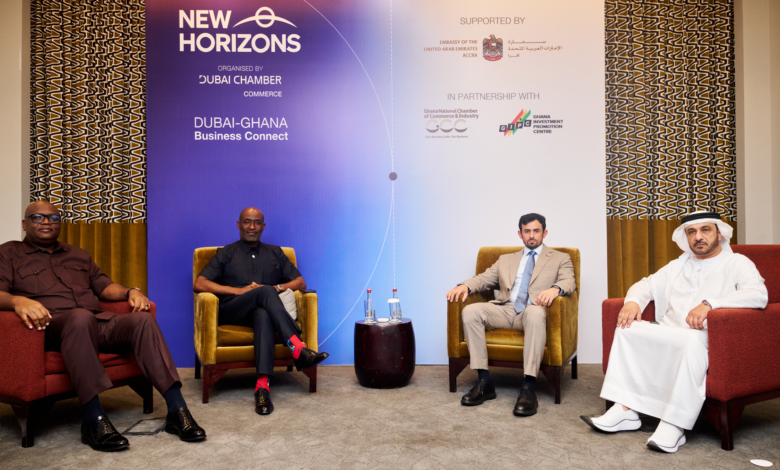
Dubai is intensifying its commercial engagement with Ghana as part of a broader strategy to expand business partnerships across Africa, with new high-level meetings in Accra placing fresh focus on trade flows, investment cooperation and private-sector expansion between the two markets.
Dubai Chambers held a series of strategic engagements with some of Ghana’s leading trade and investment institutions, including the Ghana National Chamber of Commerce and Industry, the Ghana Investment Promotion Centre and the Importers and Exporters Association of Ghana, as the emirate seeks to position itself more aggressively within Africa’s evolving trade and investment landscape.
The discussions formed part of a wider trade mission to Ghana and Ethiopia led by Dubai Chamber of Commerce under its international expansion programme aimed at identifying new business opportunities for Dubai-based firms across emerging African markets.
The mission reflects the growing importance of Africa within Gulf economies’ long-term trade diversification strategies, particularly as competition intensifies among global business hubs seeking stronger access to Africa’s fast-growing consumer markets, logistics corridors and industrial sectors.
Strengthening Commercial Corridors
The meetings in Accra were led by Salem AlShamsi, Executive Vice President of International Relations at Dubai Chambers, and focused heavily on creating stronger institutional and business linkages capable of supporting long-term commercial partnerships.
During discussions with the Ghana National Chamber of Commerce and Industry, led by its President Stéphane Miezan, both sides explored ways to facilitate bilateral trade, support investment flows and deepen cooperation between private-sector operators in Ghana and Dubai.
The talks centred on how businesses in both markets could leverage stronger institutional coordination to unlock opportunities across sectors including logistics, trade facilitation, manufacturing, services and investment promotion.
Officials involved in the discussions indicated that improving direct business connectivity between companies in both markets remains a key priority as Ghana positions itself as a regional commercial gateway within West Africa.
Ghana’s Gateway Position Attracting Attention
Dubai’s growing interest in Ghana comes as international investors increasingly view the country as an entry point into broader West African trade opportunities under the African Continental Free Trade Area (AfCFTA).
Ghana’s relative political stability, expanding digital economy, strategic Atlantic coastline and role as host of the AfCFTA Secretariat continue to strengthen its positioning within continental trade conversations.
The engagement with the Ghana Investment Promotion Centre, headed by Simon Madjie, focused on identifying investment opportunities across priority sectors while highlighting the comparative advantages available to businesses operating in both Ghana and Dubai.
The discussions also explored mechanisms for supporting stronger private-sector participation and facilitating cross-border investment flows.
For Ghanaian policymakers, attracting deeper commercial partnerships with Gulf economies is increasingly viewed as strategically important as the country seeks to diversify investment sources beyond traditional Western and multilateral financing channels.
Private Sector Partnerships in Focus
A separate engagement with the Importers and Exporters Association of Ghana, represented by Asaki Awingobit, concentrated on practical trade cooperation between businesses operating within both economies.
The discussions examined ways to improve direct communication between companies, strengthen business matchmaking opportunities and facilitate stronger export-import partnerships.
Trade analysts say such engagements could become increasingly important for Ghanaian exporters seeking greater access to international distribution networks and logistics systems linked to Dubai’s global trade infrastructure.
Dubai has spent years positioning itself as one of the world’s leading logistics and re-export hubs, connecting businesses across Asia, the Middle East, Europe and Africa.
For Ghanaian businesses, stronger commercial links with Dubai could potentially create opportunities within sectors such as agro-processing, manufacturing exports, logistics services, tourism, technology and trade financing.
Africa Becoming Central to Gulf Expansion
The Accra meetings reflect a broader shift underway within Gulf-Africa economic relations.
Countries such as the United Arab Emirates and Saudi Arabia have significantly expanded their commercial and strategic engagement across Africa in recent years, targeting sectors including ports, logistics, renewable energy, aviation, agriculture, mining and financial services.
Dubai, in particular, has aggressively positioned itself as a gateway for international companies seeking access to African markets.
Through Dubai Chambers’ international offices and trade missions, the emirate has sought to strengthen business networks capable of supporting outward expansion by Dubai-based firms into high-growth economies.
The Ghana mission therefore forms part of a much larger strategy aimed at deepening Dubai’s economic footprint across Africa.
Beyond Diplomacy to Commercial Outcomes
While institutional engagements and trade missions have become increasingly common within Africa’s investment landscape, businesses often remain more focused on practical outcomes than diplomatic symbolism.
For many Ghanaian companies, the key question will be whether the latest discussions ultimately translate into concrete investment projects, export contracts, logistics partnerships and measurable business expansion opportunities.
Trade experts note that Ghana continues to face significant challenges around export diversification, industrial financing and market access despite growing international investor interest.
The effectiveness of partnerships such as these may therefore depend largely on how quickly both sides can move from institutional dialogue toward commercially viable transactions and long-term investment execution.