
Ghana Can Turn Flowers Into Jobs and Cut Import Costs – Stratcomm CEO
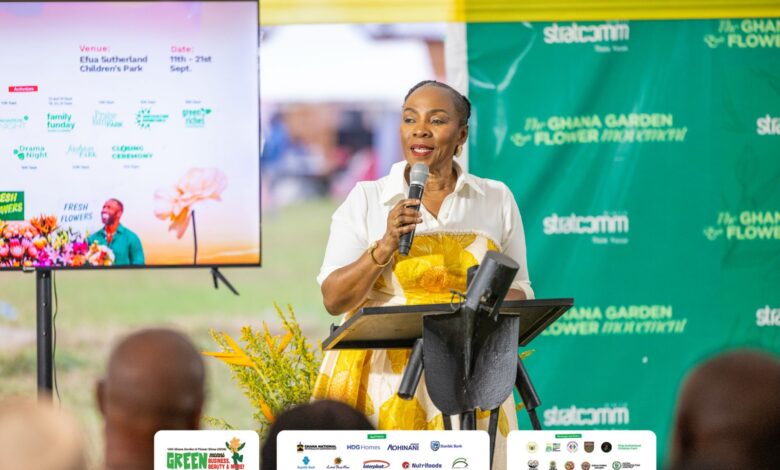
Ghana could turn its abundant land, sunshine, water and plant resources into a bigger horticulture industry capable of creating jobs, reducing dependence on imported flowers and generating new export revenues, Chief Executive Officer of Strategic Communications Africa (Stratcomm Africa), Ms Esther Cobbah, has said.
She said the country was sitting on the basic resources needed to build a commercially viable horticulture industry, even as thousands of young people remain without jobs and Ghanaian consumers continue to spend scarce foreign exchange importing flowers for funerals, weddings, birthdays and other occasions.
“We have young people on the streets with no jobs, but we have soil. We have sunshine. We have water. We have plants. Therefore, we have business, and we have jobs,” she said.

Ms Cobbah was speaking at the opening of the 14th Ghana Garden and Flower Show in Accra, held under the theme “Green Means Business, Beauty and More.”
The 2026 edition is highlighting the links between greening, enterprise, innovation, livelihoods, wellbeing and sustainable development.
Turning imports into local business
Ms Cobbah questioned why Ghana should continue using scarce foreign exchange to import flowers that could potentially be produced locally.
She also pointed to the additional cost of preserving imported flowers, arguing that Ghana should be looking at how local production can reduce both import expenditure and the energy burden associated with transporting and storing products that could be grown closer to consumers.
“Why should we use the scarce foreign exchange that we have to import flowers every weekend for funerals, for birthdays, for weddings, et cetera, when we can actually bring in foreign exchange?” she asked.
Her argument was not for an end to imports, but for Ghana to identify products it has the natural conditions to produce competitively and develop businesses around them.
“We will. But God in his wisdom gave us some that others do not have. Let’s create a business. Let’s create a business with the resources that we have around us,” she said.
The opportunity, therefore, extends beyond flower growers to a wider commercial chain involving nurseries, input suppliers, greenhouse operators, transporters, cold storage providers, landscapers, marketers and exporters.
Building an industry, not just growing flowers
Ms Cobbah said this year’s Garden and Flower Show had deliberately introduced a stronger focus on the horticulture value chain, covering production, aggregation, marketing and export.
That shift reflects the need to build an industry capable of moving products efficiently from growers to consumers and international markets.

The Vice President, Professor Naana Jane Opoku-Agyemang, reinforced that point at the event, saying the exhibition demonstrated that an entire economy exists behind gardens and flowers.
“Behind what you see immediately are growers, skills, services, markets, and livelihoods,” she said.
She said the opportunity was to help more horticultural enterprises develop into sustainable businesses capable of employing others, supplying larger markets and, where possible, competing beyond Ghana.
For the sector to achieve that scale, however, Prof. Opoku-Agyemang said Ghana must look beyond production to the infrastructure and services required to preserve and move perishable products.
Reliable transport, storage, quality standards, finance and market access, she said, would be critical to preventing value from being lost along the supply chain.
Horticulture meets the jobs challenge
For Ms Cobbah, the employment potential is one of the strongest reasons for Ghana to take the sector seriously.
Horticulture can create opportunities at different skill levels, from cultivation and nursery management to landscaping, marketing, logistics, technology and export management.
She argued that Ghana’s natural resources provide an underused platform for young people to enter productive enterprise.
The point is not simply to encourage more people to become farmers, but to build businesses around what farmers produce.
This approach also creates opportunities for young entrepreneurs to develop enterprises serving the wider horticultural ecosystem.
Green spaces can also help tackle flooding
Ms Cobbah linked the economic argument for horticulture to Ghana’s growing urban environmental challenges.
She said the proliferation of concrete surfaces in cities had reduced the space available for water to infiltrate the ground, contributing to drainage problems and flooding.
“If we had little gardens in our homes, the water would drain down and not cause floods,” she said.
She also criticised the everyday practices that contribute to blocked drains, including the disposal of sachet water bags and household waste into gutters.
Her argument was that responsibility for creating cleaner and greener communities should not rest entirely with government.
“We have a responsibility to make our country beautiful,” she said.
The economic and environmental arguments therefore intersect. More gardens and green spaces can create demand for horticultural businesses while also changing how urban communities manage land and water.
A 24-hour economy growing while people sleep
Ms Cobbah also used agriculture’s natural production cycle to make a case for horticulture as an enterprise opportunity.
She said plants could continue growing while people sleep, creating a business model in which production takes place continuously and products can be harvested and sold into markets.
“24 hour economy is God’s creation. Whilst we are sleeping, the plants grow,” she said.
She cited cabbage as an example of a crop that can grow without requiring human activity around the clock.
For young people seeking employment and income opportunities, the broader message is that horticulture can combine agriculture with enterprise, technology, creativity and commerce.
From local gardens to export markets
The ambition is ultimately larger than replacing imported flowers.
Prof. Opoku-Agyemang said Ghana had the potential to develop horticultural enterprises capable of supplying larger markets and competing internationally, but this would require attention to the entire value chain.
The 2026 show has therefore added a horticulture value-chain component covering production, aggregation, marketing and export, while also showcasing a model home designed to demonstrate opportunities in eco-friendly housing.
For Ghana, the emerging opportunity is to turn resources that are already available into productive businesses, using horticulture not only to make cities greener but also to create jobs, retain more value domestically and build new export industries.