Amref, Health Care Without Harm Forge Africa Climate-Resilient Health Partnership
As climate change puts new pressure on health systems across Africa, Amref Health Africa and Health Care Without Harm (HCWH) are joining forces to help attract investment into healthcare that can withstand climate shocks while reducing its environmental impact.
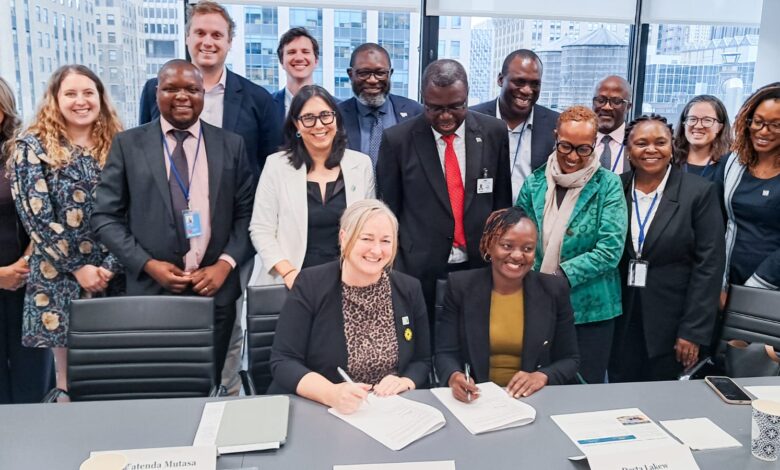
The two organisations signed a strategic partnership during the 81st United Nations General Assembly (UNGA81), combining Amref’s health and development network across Africa with HCWH’s experience in sustainable healthcare.
The partnership is expected to support local research, climate-smart health facilities and training for health professionals, policymakers and climate negotiators, while helping turn climate and health commitments into practical investments.
The agreement was formalised at a high-level UNGA81 roundtable that brought together governments, climate funds, philanthropies and civil society organisations to examine ways of increasing investment in African health systems.
From commitments to delivery
For Amref, the challenge is not necessarily a lack of climate and health priorities, but finding the money and capacity to implement them.
Amref Group Chief Executive Officer, Dr Githinji Gitahi, said African countries already knew many of the actions required but needed financing to move from plans to delivery.
“Africa does not lack climate and health priorities; what is missing is financed delivery,” he said.
He said the partnership would strengthen collaboration with governments, financing institutions and technical partners to turn climate commitments into measurable health outcomes, particularly by strengthening primary healthcare.
The two organisations will assess climate risks and carbon footprints across health systems, support climate-smart facility planning and build the capacity of healthcare workers and policymakers.
They will also identify and document solutions already being developed in African countries, with the aim of adapting and expanding approaches that could work in other settings.
The work will build on Amref’s Climate and Health Negotiators’ Curriculum, launched in September 2025, and the Centre for Policy and Research on Climate Change and Health at Amref International University.
The centre focuses on areas including climate-health data systems, health workforce resilience, health economics and financing, climate-sensitive diseases, loss and damage, gender and equity.
A changing climate, a growing health challenge
Amref Health Africa Partnership Director, Corazon Aquino, said the partnership comes as climate change is already affecting the health and wellbeing of communities across the continent.
“Climate change is already shaping the health and wellbeing of millions of people across Africa,” she said, citing droughts, floods, emerging disease patterns and food insecurity.
She said the scale of the challenge required cooperation across governments, organisations and sectors.
“It will take all of us working together to build the resilient health systems and resilient communities that our future depends on,” she said.
Aquino said discussions at UNGA81, including those on preparedness for the anticipated El Niño season, were an important starting point for putting the partnership into practice.
She said Africa should not only respond to the climate crisis but also help shape the solutions, investments and partnerships that will determine the continent’s health future.
Making healthcare greener and more resilient
HCWH brings its Global Green and Healthy Hospitals (GGHH) network to the partnership. The network has 135 members across 11 African countries and works with healthcare institutions to reduce their environmental footprint while preparing for climate impacts.
HCWH also works with groundWork, Friends of the Earth South Africa, which coordinates the GGHH network in Africa.
groundWork has contributed to research into the health effects of coal-fired power generation in South Africa and supported skills development in the health sector.
HCWH Chief Executive Officer Emily Bancroft said the partnership would combine Amref’s reach and experience across Africa with HCWH’s work on sustainable and resilient healthcare.
“By bringing together Amref’s deep community reach and leadership across Africa with our expertise in sustainable, resilient health care, we can build and scale solutions in Africa, for Africa,” she said.
Giving Africa a stronger voice
The partnership also looks beyond UNGA81, with Aquino pointing to upcoming global and regional platforms where African priorities could shape the wider climate and health conversation.
With COP32 scheduled to take place in Addis Ababa, she said Africa had an opportunity to bring its priorities, evidence and lived experiences more strongly into the global climate and health agenda.
She also identified the Africa Health Agenda International Conference (AHAIC) 2027 as another platform for bringing together leaders, practitioners, communities and partners to build on the work.
The focus, she said, should be on moving from commitments to practical results and ensuring that future generations inherit health systems that are stronger, more resilient and better prepared for a changing climate.
For Amref and Health Care Without Harm, the partnership creates a link between climate finance, research, healthcare infrastructure and skills development at a time when African health systems are facing growing climate-related pressures.
Amref, headquartered in Kenya, provides health and development services to more than 20 million people annually in at least 30 African countries.