Can Education Fix Ghana’s Insurance Problem? GIU’s 20-Year Journey Reopens the Debate
For two decades, the institution now known as the Ghana Insurance University College has produced a steady pipeline of insurance professionals serving across Ghana and parts of the West African sub-region.
What started in 2006 as the Ghana Insurance College has now evolved into a university college affiliated with the University of Ghana, marking a significant milestone for an industry that continues to struggle with low public confidence, limited technical capacity and weak market penetration.
But the institution’s elevation to university status is also reviving a deeper industry question: after 20 years of building human capital for the sector, why does insurance penetration in Ghana still remain around one percent of GDP?
That contradiction is increasingly placing the insurance industry’s talent and capacity conversation at the centre of wider national discussions around financial inclusion, economic resilience and public trust.
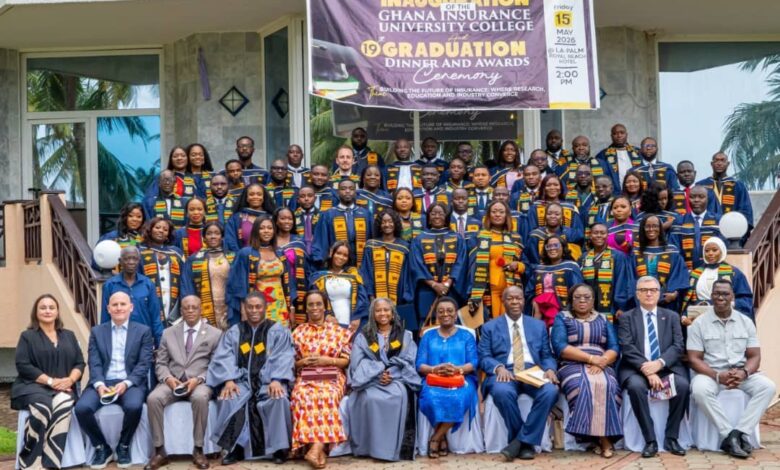
The issue featured prominently during the inauguration of the Ghana Insurance University College and its 19th graduation dinner and awards ceremony held at the La Palm Royal Beach Hotel.
Building Capacity for Two Decades
The GIU’s transformation mirrors the broader evolution of Ghana’s insurance industry itself.
Since its establishment, the institution has trained underwriters, brokers, claims professionals and risk managers who now occupy leadership and technical roles across the insurance ecosystem.
Its long-standing partnership with the Malta International Training Centre has also contributed to strengthening professional and international exposure within the sector.
Speaking at the event, Ronald Micaleff described the institution’s journey as one rooted in “commitment to knowledge, professional excellence, innovation and service to Ghana’s financial and insurance sectors.”
“Nineteen years is not merely a measure of time,” he said. “Institutions such as this help shape the confidence of nations. They create professionals who do not simply respond to risk, but who build trust, resilience and opportunity within society.”
His remarks underscored a growing industry concern that Ghana’s insurance growth problem extends beyond regulation and products into the areas of trust, literacy and public engagement.
Human Capital Versus Market Reality
Despite years of reforms and expansion within the financial services industry, insurance penetration in Ghana remains among the lowest across emerging markets.
The figure, estimated at roughly one percent of GDP, continues to expose the disconnect between industry growth and consumer adoption.
While banking and digital financial services have expanded rapidly across the country, insurance remains poorly understood by many households and small businesses, particularly within Ghana’s largely informal economy.
Analysts say the challenge is driven not only by affordability constraints, but also by weak public confidence, poor understanding of insurance products, limited innovation and lingering concerns around claims settlement.
That reality is increasingly elevating the strategic importance of institutions like the GIU.
Industry observers argue that future growth may depend on whether the sector can produce professionals capable not only of underwriting risk, but also designing inclusive products, applying data analytics, driving digital transformation and rebuilding trust among consumers.
Education as a Competitive Tool
The Acting Commissioner of Insurance, Dr Abiba Zakariah, linked the future competitiveness of Ghana’s insurance sector directly to education and skills development.
Addressing graduates, she stressed the need for professionals willing to embrace innovation, continuous learning and ethical leadership.
She described education as “the foundation upon which professional excellence is built,” arguing that technical competence and leadership would determine how effectively insurers respond to changing consumer expectations and emerging risks.
Her comments reflect growing recognition within the sector that Ghana’s insurance penetration challenge is not purely regulatory, but also deeply connected to human capital development.
As financial services become increasingly digital across Africa, insurance firms are demanding stronger expertise in actuarial science, risk modelling, data analytics and systems integration.
The GIU’s new direction appears designed to respond to that shift.
New Status, Bigger Expectations
The Rector of the GIU, Dr Richard Okyere, announced that the institution’s affiliation with the University of Ghana would support the rollout of new academic programmes from September.
Among the flagship offerings are Bachelor of Science degrees in Actuarial Science with Insurance and Insurance Studies, alongside insurance-linked integration into Computer and Data Science programmes.
The strategic significance is considerable.
Globally, insurance firms are increasingly relying on predictive analytics, artificial intelligence and data-driven risk assessment systems to improve pricing, fraud detection and customer engagement.
For Ghana, where insurance penetration remains persistently low, the GIU’s transition signals an attempt to reposition insurance education beyond traditional underwriting into broader technology-driven risk management and financial intelligence.
A message delivered on behalf of the Vice-Chancellor of the University of Ghana, Prof. Nana Aba Appiah Amfo, described the institution’s elevation as “not merely a change of name, but a change of altitude.”
The University of Ghana also reaffirmed its commitment to mentoring the GIU to maintain high standards in teaching, research and academic delivery.
The affiliation arrangement will also support the introduction of new programmes in actuarial science and statistics with insurance, reflecting the growing convergence between finance, technology and risk management.
Can Insurance Become More Relevant?
The broader challenge facing the industry is whether insurance can become more relevant to households, SMEs and vulnerable sectors of the economy.
Ghana’s economy remains exposed to climate risks, health emergencies, business disruptions and agricultural shocks, yet insurance uptake remains limited across many sectors.
Low penetration means households and businesses frequently absorb financial shocks directly, slowing recovery and weakening economic resilience.
For the GIU, the bigger test following its elevation may therefore go beyond producing graduates.
The institution’s long-term impact may ultimately depend on whether its graduates can help the industry expand access through affordable microinsurance, improved agricultural coverage, SME-focused solutions and digital distribution platforms capable of reaching underserved populations.
Industry Veterans Recognised
The ceremony also honoured several individuals who played key roles in shaping both the institution and Ghana’s insurance industry since 2006.
Among those recognised were former Commissioners of Insurance including Dr Justice Ofori, Josephine Jennifer Amoah and Nyamikeh Kyiamah.
Former insurance executives, governance contributors and industry resource persons were also honoured for their contributions to the sector’s development.
The event additionally saw the swearing-in of the GIU Governing Council and Academic Board, marking the beginning of the institution’s transition into a fully operational university college structure.
Beyond Graduation Ceremonies
The GIU’s elevation comes at a pivotal moment for Ghana’s insurance industry.
The sector faces mounting pressure to modernise, deepen inclusion, improve trust and play a more visible role within the country’s broader economic development agenda.
For nearly two decades, the institution has helped build technical capacity for the industry.
The larger national question now is whether that educational investment can finally help Ghana’s insurance sector move beyond its persistently low penetration levels and establish itself as a stronger pillar of financial stability and economic resilience.