Africa’s street traders and market vendors are pushing for a bigger place in the continent’s social protection systems as millions of workers continue to earn their livelihoods outside the formal economy.
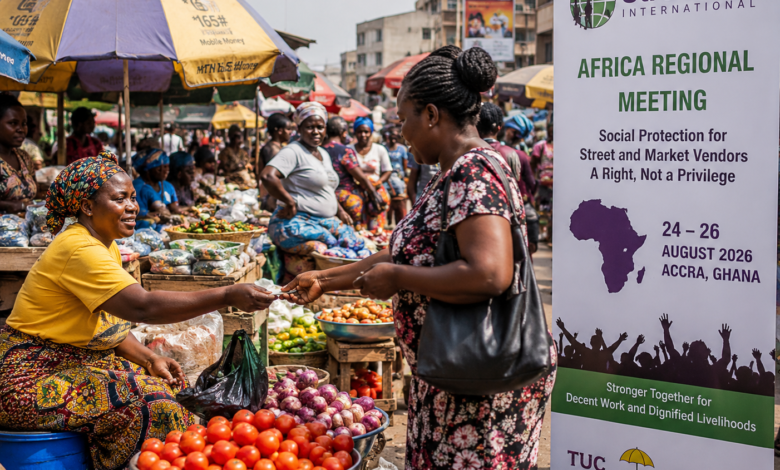
Leaders of informal traders’ unions, cooperatives and associations from 24 African countries will meet in Accra from August 24 to 26 to develop strategies for securing social protection and better working conditions for street and market traders.
The meeting, organised by StreetNet International and hosted by the Trade Union Congress (TUC) of Ghana in collaboration with the Union of Informal Workers Associations (UNIWA), will bring together 35 participants at the Erata Hotel.
The discussions come as the informal economy remains a major source of employment across Africa, but many of the workers who depend on it have limited access to pensions, health insurance, unemployment protection and other social security benefits.
A workforce outside the safety net
StreetNet International President Lorraine Ndhlovu said the scale of informality in Africa makes the issue too important to ignore.
“Africa has high levels of informality accompanied by stark deficiency to absence of social protection for informal economy workers,” she said.
She noted that street vendors, market vendors and hawkers make up a significant part of the informal workforce but often operate without the protections available to formal employees.
StreetNet International represents more than 800,000 informal economy workers across 56 countries, giving the meeting a significant regional reach.
For traders, the issue is not simply about government assistance. Access to social protection can determine whether a vendor can survive an illness, injury, loss of income or retirement without falling into deeper financial hardship.
The cost of staying informal
The discussions also highlight a broader economic challenge for African governments.
Informal businesses provide jobs and livelihoods for millions, yet their workers and enterprises often operate outside systems designed to provide social security, access to finance and other forms of formal economic support.
StreetNet wants social protection to become part of efforts to gradually move informal businesses into more formal economic structures.
Its priorities include universal social protection for informal workers, promoting the social and solidarity economy as a pathway to formalisation, and strengthening the participation of women and young workers.
Why it matters to Ghana
Ghana is no stranger to the challenge.
Street vendors, market traders, food sellers, artisans and other informal operators are a visible part of the country’s economic landscape. They provide employment and essential goods and services, while supporting thousands of households.
Yet many operate without the protections enjoyed by workers in formal employment.
The Accra meeting therefore gives Ghana an opportunity to be part of a wider African discussion about how governments can expand social protection without undermining the livelihoods of people who depend on informal trading.
From street trading to decent work
StreetNet International Coordinator Oksana Abboud said the organisation wants to work with governments and local authorities rather than simply campaign against them.
“StreetNet remains committed to advocating and negotiating with key partners, including municipal and national decision-makers, to ensure that every informal trader can access decent working conditions and a dignified livelihood,” she said.
That approach places the informal economy within a bigger conversation about jobs, productivity and economic development.
For Africa, the challenge is no longer simply how to move informal workers into the formal economy. It is also how to ensure that workers who remain informal are not left without basic economic and social protection.
The Accra meeting will seek to turn that concern into practical strategies that governments, trade unions and informal workers’ organisations can take forward across the continent.