Emirates Crosses 100-Aircraft Retrofit Milestone as US$5bn Cabin Upgrade Accelerates
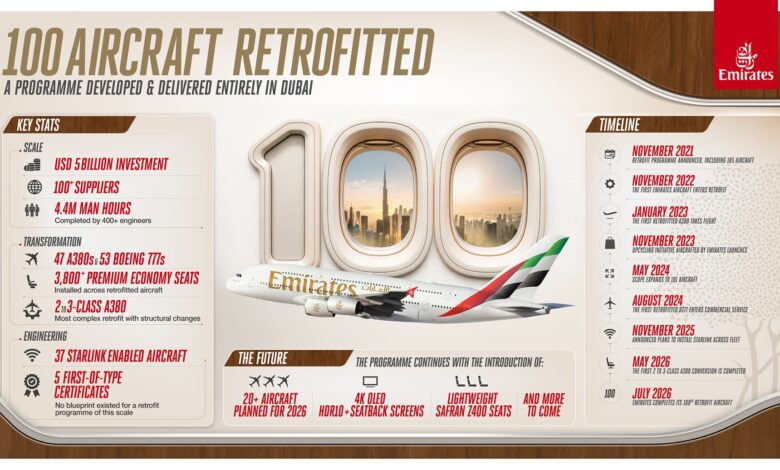
Emirates has completed the refurbishment of 100 aircraft under what it describes as the world’s largest aircraft retrofit programme, marking a major milestone in its US$5 billion investment to modernise its fleet and expand its premium travel offering.
The airline said 47 Airbus A380s and 53 Boeing 777 aircraft have undergone complete cabin upgrades since the programme began in November 2022, with work carried out entirely at Emirates Engineering facilities in Dubai.
By the end of December 2026, the airline expects to retrofit about 20 more aircraft, pushing the programme beyond its halfway point as it seeks to standardise the onboard experience across its long-haul fleet.
The project represents one of the aviation industry’s largest fleet modernisation investments at a time when airlines globally are extending the life of existing aircraft amid delivery delays for new jets and rising demand for international travel.
Premium Economy Rollout Gains Momentum
A key feature of the retrofit programme has been the installation of Emirates’ Premium Economy cabin across refurbished aircraft.
More than 3,800 Premium Economy seats have now been fitted, enabling the airline to deploy the product on more routes across its global network as customer demand for mid-tier premium travel continues to grow.
Emirates President Sir Tim Clark described the programme as central to the airline’s strategy of maintaining a premium customer experience across all cabin classes.
“Our commitment to deliver best-in-class products across every cabin is an ongoing endeavour, and completing full cabin retrofits for 100 wide-body aircraft in 44 months is a significant achievement,” he said.
According to him, the investment allows Emirates to continue offering enhanced comfort and luxury while demonstrating the engineering capabilities developed in-house in Dubai.
Massive Engineering Operation
Since the programme began, more than 400 engineers and technicians have invested approximately 4.4 million man-hours to complete the refurbishment of the first 100 aircraft.
Each retrofit involves stripping aircraft interiors, replacing cabin components and installing thousands of new parts before the aircraft returns to commercial service.
An Airbus A380 requires more than 4,000 individual replacement parts during refurbishment, while a Boeing 777 uses over 2,500 parts.
To manage the scale of the programme, Emirates Engineering developed specialised equipment, redesigned work processes and collaborated with more than 100 suppliers.
The airline said it currently retrofits an average of 28 aircraft annually.
Fleet Upgrade Expands
Emirates initially announced the programme in 2021 covering 105 aircraft.
Strong passenger demand prompted the airline to expand the initiative to 191 aircraft in 2024 before increasing the scope again to 219 aircraft later that year.
The first retrofitted Boeing 777 entered commercial service in August 2024.
The programme continues to evolve. From October 2026, Emirates plans to introduce next-generation 4K OLED HDR10+ seatback entertainment screens and lightweight Safran Z400 seats as part of the next phase of cabin enhancements.
Sustainability Built Into the Programme
Beyond fleet modernisation, Emirates said the project is also supporting its sustainability objectives.
Materials removed from refurbished aircraft, including premium leather and cabin fabrics, are being repurposed into limited-edition travel accessories under its Aircrafted by Emirates collection.
The airline has also converted retired Economy Class seat fabrics into more than 4,000 school backpacks distributed to children in 11 countries.
The retrofit programme reflects a broader industry trend in which airlines are investing heavily in upgrading existing aircraft to improve passenger experience, preserve fleet value and support long-term growth while awaiting deliveries of new-generation aircraft.