Ghana’s Oil Window Is Closing. GNPC Must Now Deliver More Value
Ghana has a narrowing window to turn its remaining oil and gas resources into lasting economic gains, putting pressure on the Ghana National Petroleum Corporation (GNPC) to strengthen its capacity, sharpen investment decisions and deliver greater value to the economy.
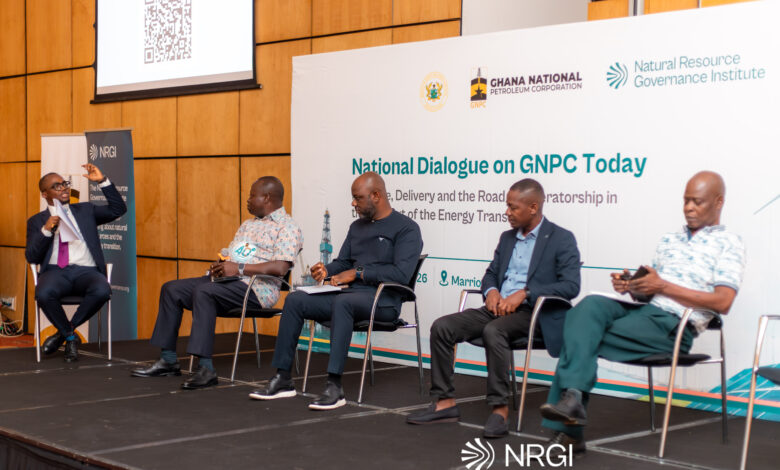
That challenge dominated a national stakeholder dialogue on the future of the state-owned oil company, as policymakers, civil society and industry players examined GNPC’s ambition to take on greater responsibility for petroleum operations.
The dialogue, organised by the Natural Resource Governance Institute (NRGI), was held under the theme “GNPC Today: Mandate, Delivery and the Road to Operatorship in the Context of Energy Transition.”
For NRGI Africa Director Nafi Quarshie, the debate over operatorship cannot be separated from the larger question of how Ghana will use its remaining petroleum wealth to support development.
“Resources do not transform economies, decisions do,” Quarshie said, arguing that governance, execution and strategic choices will determine whether Ghana converts its natural resources into sustainable development.
The urgency is growing.
Ghana’s existing oil fields are maturing and production has fallen by nearly half from its 2019 peak, according to NRGI. At the same time, the country still has significant resource potential and is seeking new upstream investment.
This leaves Ghana facing a difficult balancing act: maximise the value of its remaining petroleum resources while avoiding investments and risks that could become costly as the global energy system shifts towards cleaner sources.
From oil production to development
For Quarshie, GNPC’s transformation should therefore not be treated as a corporate restructuring exercise.
It is a national development and governance issue.
She said the strongest national oil companies globally are not necessarily those that expand the fastest or diversify into the most businesses. Instead, they tend to be those that make deliberate strategic choices, maintain clear mandates, enforce strong governance and operate with commercial discipline.
For Ghana, that means determining exactly what GNPC should become, how much risk it should take and how its commercial activities should contribute to national development.
The answers will become increasingly important as the country seeks to use oil and gas to strengthen energy security, support industrialisation and build economic opportunities beyond the lifespan of its petroleum reserves.
GNPC: More than a commercial oil company
GNPC Chief Executive Officer Kwame Ntow Amoah pushed back against comparisons between the corporation and conventional private oil companies.
He said GNPC’s role has historically extended beyond profit-making to opening up Ghana’s petroleum frontier and taking risks that private investors were initially unwilling to assume.
He cited the corporation’s involvement in offshore exploration during the 1980s and 1990s, including periods when GNPC operated wells itself.
The discoveries that eventually transformed Ghana into an oil-producing country, he argued, were built on years of exploration and investment rather than a single commercial intervention.
This history, he said, is important to understanding why GNPC cannot simply be assessed like a private company whose primary objective is to maximise returns from individual assets.
“Profit is important. But the sustainability of the resource is also important,” Amoah said.
That distinction is central to the development role expected of a national oil company.
GNPC must generate commercial value, but it must also protect the long-term interests of the state, build Ghanaian technical expertise and ensure that petroleum assets are developed responsibly.
Operatorship must prove its worth
GNPC’s ambition to become a stronger operator is consequently attracting increasing attention.
But the stakeholder dialogue raised an important question: What should Ghana actually gain from operatorship?
For Amoah, the answer should be visible in performance.
He acknowledged that GNPC faces legitimate questions about its performance, allocation of resources, commercial position and transformation.
The corporation, he said, must respond through improved operational results, stronger financial discipline, better investment decisions, deeper Ghanaian technical capacity and greater transparency.
That would make operatorship more than a change in corporate status. It would make it a means of increasing the value Ghana derives from its petroleum resources.
Gas could be the bigger development opportunity
While crude oil production is declining, natural gas is becoming increasingly important to Ghana’s economic strategy.
Government has positioned gas as an anchor for energy security, creating an opportunity to connect the petroleum sector more closely to industrialisation.
Reliable domestic gas can support power generation and provide feedstock for industries, potentially reducing dependence on imported energy and improving the competitiveness of domestic businesses.
That makes decisions on new upstream investment, gas infrastructure and resource development particularly consequential.
Ghana’s remaining hydrocarbons therefore present a choice.
The country can treat them primarily as a source of government revenue, or use the remaining production window to build infrastructure, energy security, industrial capacity and technical expertise that will continue generating value after petroleum production declines.
Avoiding the energy transition trap
The global energy transition makes that choice more complicated.
Oil and gas investments increasingly face uncertainty over future demand, financing and asset values. For Ghana, committing large amounts of capital to projects without properly assessing these risks could leave the country with assets that generate less value than expected.
NRGI is therefore calling for a more deliberate approach to GNPC’s investment and diversification strategy.
The corporation must understand where it can compete, how much risk it can afford to take and which investments are most likely to generate sustainable national value.
For Amoah, this does not mean GNPC should operate in isolation.
He stressed that partnerships remain fundamental to the petroleum industry because of the scale and risks involved.
Even large international oil companies share risks through partnerships rather than attempting to finance and execute every project alone.
For Ghana, maintaining credible partnerships while steadily building domestic technical and commercial capacity could therefore offer a more sustainable route to greater participation.
The development test
The debate ultimately comes down to a simple question: Can Ghana extract more value from its petroleum resources before the opportunity narrows further?
GNPC will be central to that effort.
But becoming an operator is not, by itself, the measure of success.
The real test will be whether a stronger GNPC can make better investment decisions, manage petroleum assets more effectively, develop Ghanaian expertise, support energy security and ensure that oil and gas revenues contribute to a more productive economy.
For Quarshie, the consequences extend well beyond the corporation.
Decisions being made today about GNPC’s mandate, governance, investment strategy and operatorship will shape what Ghana leaves for future generations.
The country therefore needs an oil company that is not simply bigger or more powerful, but one that is more capable, accountable and firmly aligned with Ghana’s long-term development interests.
With production already declining and the global energy system changing, the time available to get that equation right is becoming shorter.