Small-Scale Miners Become Ghana’s Biggest Gold Producers
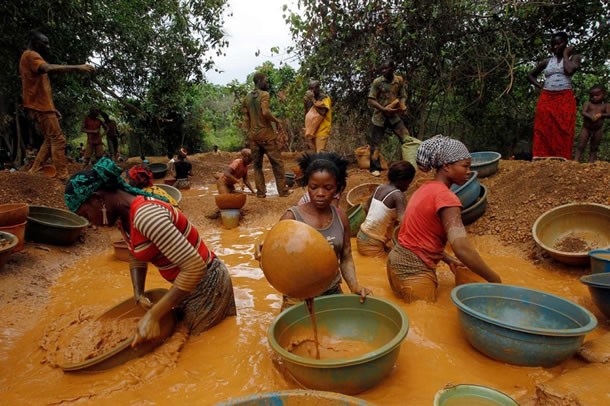
For the first time in more than a century of commercial mining, Ghana’s small-scale miners have overtaken large-scale mining companies as the country’s largest source of gold production, marking a watershed moment for an industry that remains the backbone of the national economy.
The historic shift was revealed at the 98th Annual General Meeting of the Ghana Chamber of Mines in Accra, where industry data showed that small-scale mining accounted for the majority of Ghana’s gold output in 2025, reflecting the growing economic significance of a sector long viewed as peripheral to the country’s mining landscape.
The development comes amid a record year for Ghana’s gold industry, with total attributable gold production surging by 23.4 percent to 5.94 million ounces in 2025, up from 4.82 million ounces in 2024.
Driving that growth was an extraordinary performance by the small-scale mining subsector.
Output from small-scale operators jumped by 63.8 percent, rising from 1.90 million ounces in 2024 to 3.11 million ounces in 2025. The increase pushed the sector’s share of national gold production to 52.4 percent, surpassing the contribution of large-scale mining companies, which accounted for 47.6 percent.
The figures effectively end more than 100 years of dominance by large-scale mining firms, which have traditionally defined Ghana’s gold industry.
Gold Board Reforms Fuel Surge
The Chamber linked the dramatic increase largely to ongoing reforms aimed at formalising the sector, particularly the establishment of the Ghana Gold Board, which has sought to improve gold purchasing, traceability, regulation and market access for small-scale miners.
The reforms appear to be yielding tangible results, with formalised production channels helping to bring more output into the official economy.
The milestone also highlights the increasingly important role of community-based mining operations in supporting Ghana’s export earnings, foreign exchange inflows and rural livelihoods.
Large-Scale Miners Lose Their Grip
While small-scale miners expanded aggressively, large-scale producers experienced a contraction in output.
Production from the large-scale mining sector declined by 2.98 percent to 2.83 million ounces in 2025, down from 2.92 million ounces the previous year.
As a result, the sector’s share of national gold production dropped sharply from 60.6 percent in 2024 to 47.6 percent in 2025.
The Chamber’s producing member companies collectively recorded output of 2.77 million ounces, a decline of 3.08 percent from the 2.86 million ounces produced in 2024.
The downturn reflected lower production across several operations, although gains at Asanko Gold Mine and AngloGold Ashanti’s Obuasi Mine helped moderate the decline.
Additional support came from output at Newmont’s Ahafo Mine, Cardinal Resources’ Namdini Mine and Zijin Mining’s Akyem Mine following its acquisition from Newmont.
Despite the decline, Chamber-member companies still accounted for 98 percent of industrial-scale gold production. However, their contribution to overall national output fell from 59.4 percent to 46.7 percent within a year.
A New Mining Reality
The changing production landscape could have far-reaching implications for mining policy, revenue mobilisation and environmental management.
With small-scale miners now producing the majority of Ghana’s gold, policymakers may face increasing pressure to accelerate formalisation efforts while addressing longstanding concerns over illegal mining, land degradation, water pollution and mine reclamation.
The figures also reinforce the growing importance of integrating small-scale miners into formal value chains to improve transparency, tax collection and sustainable mining practices.
Industry analysts say the latest data signals a structural shift rather than a temporary anomaly, particularly as formalisation efforts continue to expand.
Mixed Results Across the Minerals Sector
Beyond gold, Ghana recorded growth in other key minerals during 2025.
Manganese production increased by 3.85 percent to 5.2 million tonnes, up from 5.0 million tonnes in 2024, while bauxite output expanded by 21.9 percent on the back of continued investment and operational improvements.
Diamond production, however, suffered a significant setback.
Output declined by 40.7 percent from 332,297 carats in 2024 to 197,233 carats in 2025. The Chamber attributed the fall to weak natural diamond prices, growing competition from synthetic diamonds and subdued global demand.
Defining Moment for Ghana’s Gold Industry
The 2025 results may be remembered as one of the most consequential turning points in Ghana’s mining history.
For decades, multinational mining companies have dominated the country’s gold sector, shaping investment, exports and production trends. The latest figures suggest that the centre of gravity is shifting.
Small-scale miners, once regarded as marginal players, have emerged as Ghana’s single largest source of gold production.
Whether this marks the beginning of a long-term transformation will depend on the success of ongoing reforms, the ability to strengthen environmental safeguards and the sector’s capacity to sustain growth while operating within a formal and regulated framework.
What is clear, however, is that Ghana’s mining industry has entered a new era—one in which the small-scale miner has become the industry’s biggest producer.