
Ghana’s Banking Reset: From Bad Loans to Better Credit
By: Prof. Samuel Lartey
Ghana’s banking sector is showing important signs of recovery. The latest Bank of Ghana data indicate that the stock of non performing loans declined from GH¢20.7 billion in June 2025 to GH¢19.9 billion in June 2026. More significantly, the banking industry’s non performing loan ratio fell sharply from 23.1 percent to 16.1 percent, while the adjusted ratio, excluding fully provisioned loss loans, declined from 8.5 percent to 4.6 percent.
This improvement is taking place against a backdrop of greater economic stability, expanding credit and stronger regulatory attention. Ghana’s real GDP grew by 6.0 percent in 2025, while second quarter 2026 growth also stood at 6.0 percent. Inflation was 5.0 percent in August 2026. These developments provide a more supportive environment for banks, businesses, investors and households.
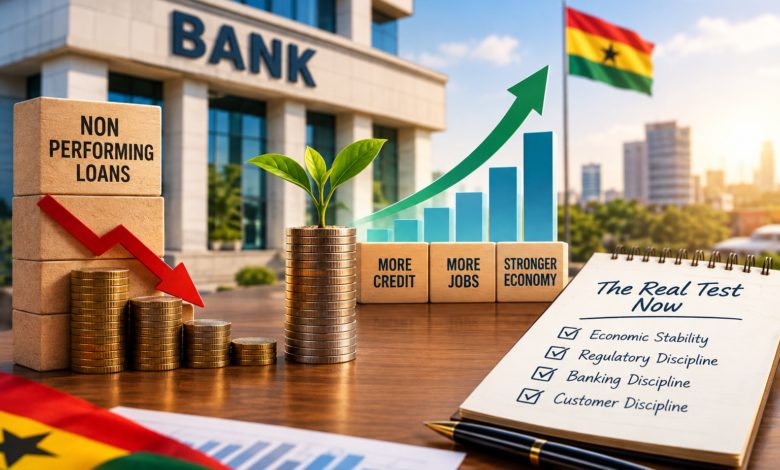
However, the sustainability of the recovery will depend on four interconnected factors: economic stability, regulatory discipline, banking discipline and customer discipline.
A Banking Sector Showing Signs of Recovery
| Indicator | June 2025 | June 2026 | Change |
| Non performing loans | GH¢20.7bn | GH¢19.9bn | Down 3.9% |
| NPL ratio | 23.1% | 16.1% | Down 7.0 percentage points |
| Adjusted NPL ratio | 8.5% | 4.6% | Down 3.9 percentage points |
| Gross loans and advances | Approx. GH¢89.2bn | GH¢124.3bn | Up 39.4% |
The figures reveal an important economic development. Gross loans and advances expanded by approximately 39.4 percent, while the stock of non performing loans declined by about 3.9 percent. Consequently, the NPL ratio fell by about 30.3 percent in relative terms.
Credit to private enterprises and households also increased by 39.6 percent to GH¢119.1 billion. This suggests that financial intermediation is expanding at a time when asset quality is improving.
The challenge is to ensure that this credit expansion finances productive economic activity rather than creating another accumulation of distressed loans.
Economic Stability Provides the Foundation
A healthy banking system requires a reasonably stable macroeconomic environment. High and unpredictable inflation can undermine household purchasing power, increase business costs and weaken borrowers’ ability to service loans.
Ghana’s current environment is considerably more stable. Inflation has fallen substantially, while economic growth remains relatively strong. This creates greater predictability for businesses and gives banks a better basis for assessing credit risk.
However, stability must be sustained. Fiscal discipline, prudent monetary management, exchange rate stability and continued structural reforms remain important to preventing another deterioration in credit quality.
Regulatory Discipline Must Remain Firm
Regulation is central to maintaining confidence in the financial system. The Bank of Ghana has continued to strengthen measures aimed at addressing non performing loans across banks, specialised deposit taking institutions and non bank financial institutions.
Effective regulation requires banks to identify distressed assets early, maintain adequate provisions, restructure viable loans and pursue recovery where appropriate. It also requires accurate reporting and consistent enforcement.
Regulatory discipline is therefore not simply about protecting banks. It protects depositors, borrowers, investors and the wider economy.
Banks Must Exercise Greater Discipline
The private sector accounted for 98 percent of total NPLs in June 2026, compared with 96.4 percent a year earlier. The public sector’s contribution declined from 3.6 percent to 2 percent.
| Borrower | June 2025 | June 2026 |
| Private sector | 96.4% | 98.0% |
| Public sector | 3.6% | 2.0% |
The concentration partly reflects the dominance of the private sector in bank borrowing. Nevertheless, banks must strengthen credit appraisal, cash flow analysis, borrower monitoring, collateral assessment and early warning systems. Rapid credit growth should never become an excuse for weaker lending standards.
Customers Must Also Exercise Discipline
Borrower behaviour is equally important. A loan is not income. It is a contractual financial obligation.
Businesses must borrow for productive purposes, maintain sound financial records and protect cash flows for repayment. Households must assess their income, expenditure and repayment capacity before taking on additional debt.
Without customer discipline, regulatory reforms and stronger banking practices will not be sufficient to prevent future NPL accumulation.
Implications for Businesses, Investors and Households
| Stakeholder | Implications |
| Businesses | Greater credit availability can support investment, expansion and employment |
| Investors | Improving asset quality can strengthen confidence in financial institutions |
| Households | Better banking conditions can improve access to housing, education and enterprise finance |
| Banks | Falling NPLs can reduce provisioning pressure and strengthen lending capacity |
| Government | A stronger financial sector can support private sector led economic growth |
Nevertheless, significant risks remain. Agriculture, forestry and fishing recorded an NPL ratio of 65.1 percent in June 2026, demonstrating that national improvement can coexist with serious sector specific vulnerabilities.
Conclusion
Ghana’s declining non performing loans represent an encouraging milestone for the financial sector and the wider economy. Yet the real achievement will not be the reduction recorded in one year. It will be the ability to sustain the improvement while expanding productive credit.
The country therefore needs a culture of economic stability, regulatory discipline, responsible banking and responsible borrowing.
The message is clear. Banks must lend prudently. Businesses must use credit productively. Households must borrow responsibly. Investors must examine underlying risks. Regulators must remain vigilant.
Ghana does not simply need more credit. It needs better credit.
If that principle becomes embedded in the financial system, the decline in bad loans could provide a stronger foundation for investment, business expansion, employment creation and inclusive economic growth.